




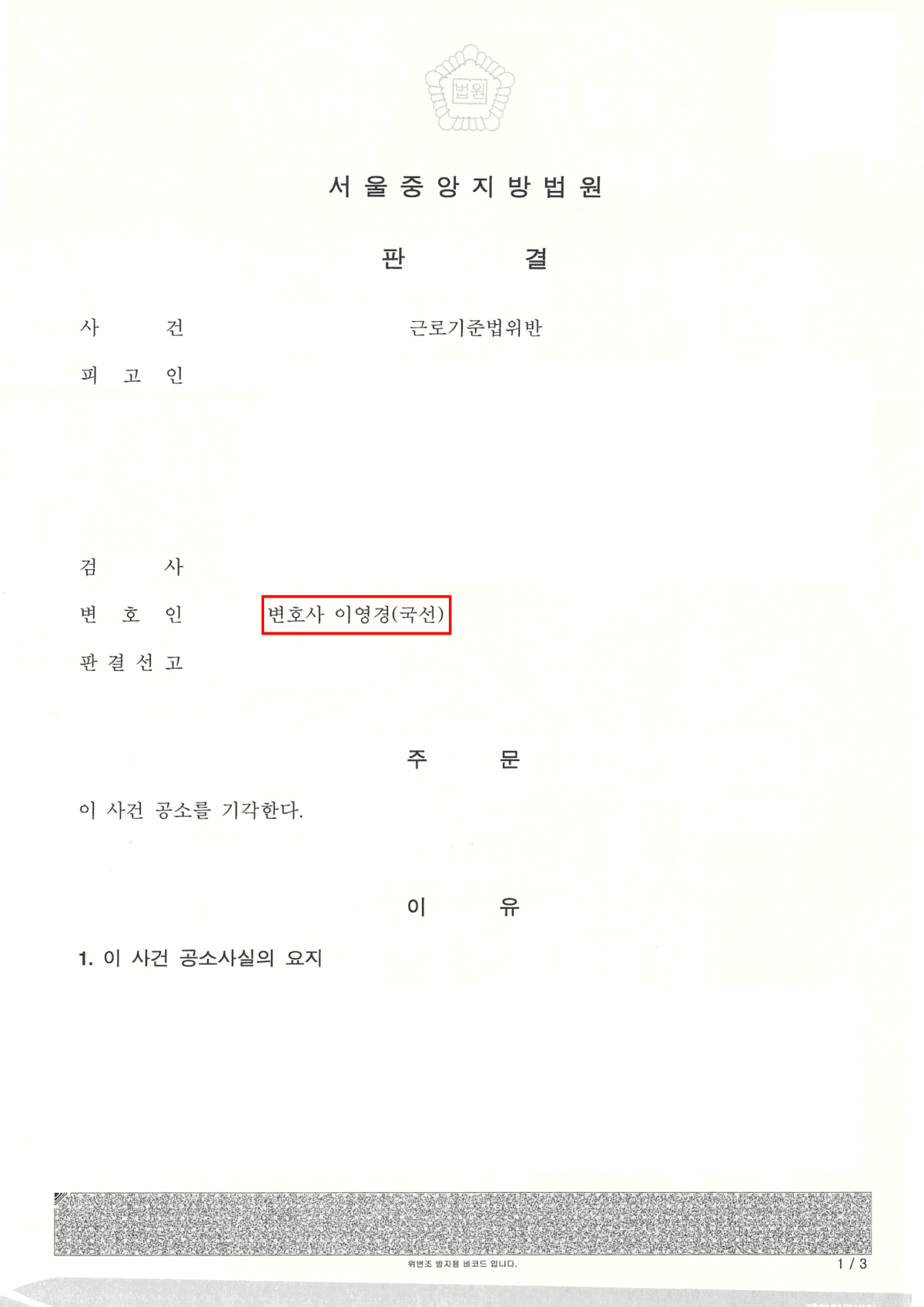
Cheongchul Law Firm (Attorney in charge: Lee Young-gyeong) assisted the defendant in a case prosecuted for violation of the Labor Standards Act due to the failure to pay employee wages and severance pay, leading to a ruling of dismissal of the charges.
If an employer fails to pay wages or severance pay to an employee, the worker files a complaint with the local employment and labor office where the business is located, and after an investigation by a labor inspector, the unpaid wages are first confirmed. If the employer complies with the labor inspector's corrective orders, the case is concluded; however, if not, civil and criminal proceedings will proceed together with complaints and civil suits from the employee side.
The defendant, while operating a hospital, failed to pay the wages of about 18 million won for employees who worked at the business within 14 days of the cause of payment arising, without an agreement regarding the extension of the payment date between the parties. As a result, there was a complaint from the worker’s labor office, and the prosecution provisionally indicted the defendant for violating the Labor Standards Act, while the defendant was in a situation where he requested a formal trial.
At that time, the defendant was in a financially difficult situation due to several lawsuits arising from the hardships of the hospital he was operating, in addition to this case. Under such circumstances, the defendant had requested a formal trial on the premise that there was an agreement on the amount of wage payments with the workers, but upon detailed consultation, it was confirmed that there were also unclear parts in that content.
Article 36 of the Labor Standards Act stipulates that the employer is obliged to pay wages, etc., within 14 days of the employee's resignation, and if violated, the employer may face imprisonment of up to 3 years or a fine of up to 30 million won under Article 109 (1) of the Labor Standards Act. However, the crime of violating the Labor Standards Act due to unpaid wages is considered a 'non-complainant offense,’ which cannot be prosecuted against the explicit will of the victim (the worker); thus, even during the trial of the first instance, if an agreement is reached with the worker and a declaration of non-prosecution is expressed, a ruling of dismissal of the charges will be issued.
After consulting with the defendant, I explained that the best option currently available is to settle with the worker and conclude both the criminal and civil proceedings at once. Accordingly, the defendant negotiated with the victim before the first trial date and submitted a settlement agreement.
The court recognized that, during the trial process, the worker explicitly expressed the intention not to seek punishment against the employer, and thus, a ruling of dismissal of the charges was issued under Article 327 (6) of the Criminal Procedure Act. As a result, the defendant was able to resolve the dispute with the worker early.
While actively disputing in case of a dispute can be a good method at times, there are often situations where it is beneficial for clients to confirm the reasons and evidence in detail and settle the dispute early through an agreement.
Cheongchul Law Firm is composed of lawyers with extensive experience in handling various labor-related cases such as wages, severance pay, and wrongful dismissal at large law firms and the Legal Aid Corporation.
If you have any questions regarding labor disputes, please do not hesitate to contact Cheongchul.
Related work cases that are good to see together


서울 강남구 테헤란로 403 리치타워 7층
Tel. 02-6959-9936
Fax. 02-6959-9967
cheongchul@cheongchul.com
개인정보처리방침
면책공고
© 2025. Cheongchul. All rights reserved