1. Introduction
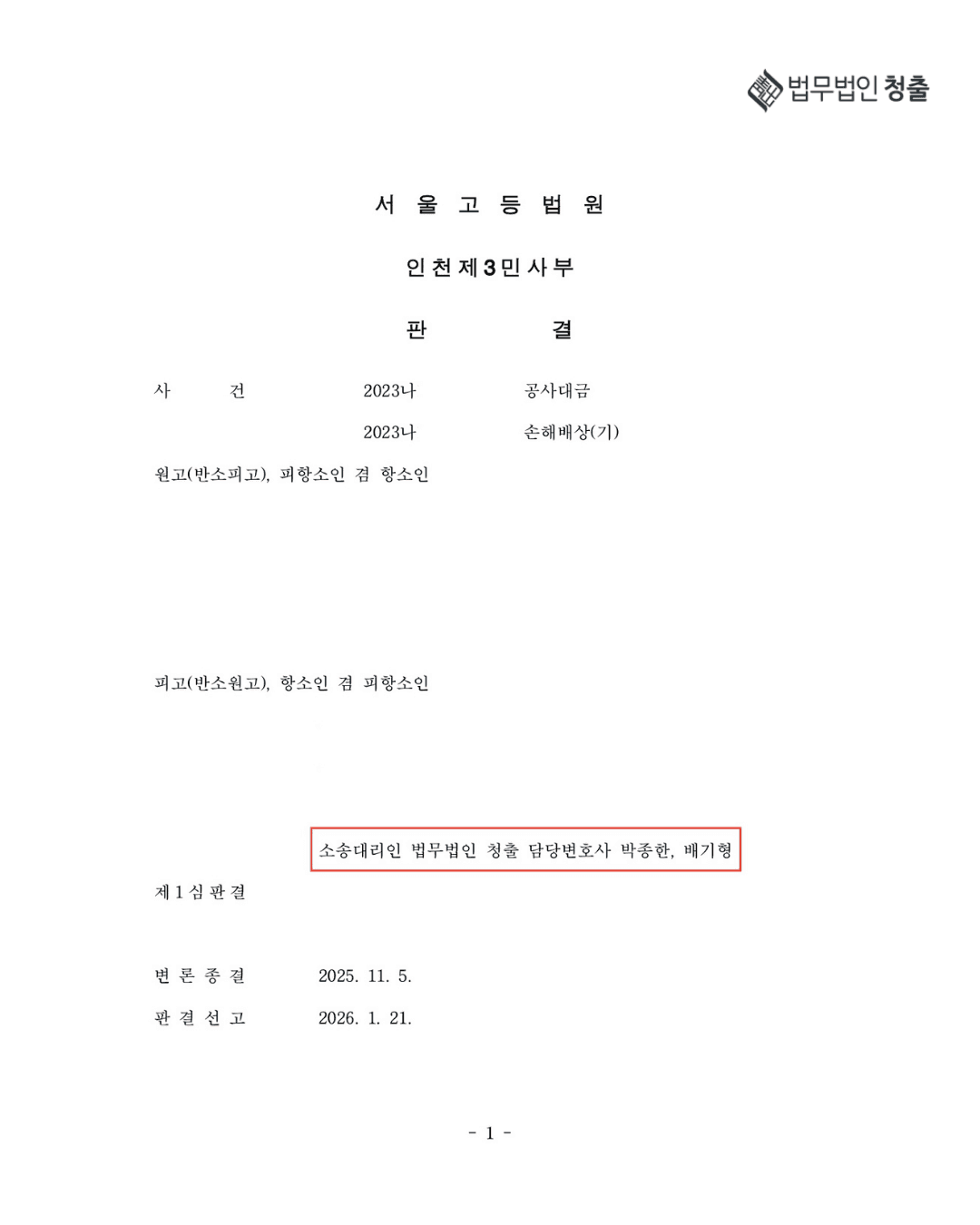
The law firm Cheongchul (Attorneys: Bae Gi-hyeong, Park Jong-han) represented the client and achieved the result of reducing the first-instance judgment of 310 million won to 110 million won on appeal, concerning the construction payment case claimed by the contractor. Although the appellate court maintained the first-instance decision on the contentious additional construction costs regarding design changes, it overturned the first-instance judgment regarding (i) roof waterproofing (slope) defects and (ii) delay damages (attribution of delay responsibility), acknowledging the contractor’s claim for compensatory damages in that amount and offsetting it against the construction payments, resulting in a substantial reduction of the original main claim.
This case comprehensively dealt with issues commonly arising from construction disputes such as design changes, additional work, delay damages, and defect repair liability under a total amount contracting structure. Cheongchul systematically reconstructed the related documents and daily reports to derive a conclusion more favorable than that of the first instance.
2. Case Background
The contractor claimed the specific construction payments and additional/changed construction costs according to the contract, while the client counterclaimed compensatory damages for construction defects and delay damages due to construction delays.
However, the first instance did not recognize the significant roof waterproofing (slope) defect among the defect items and dismissed all delay damages due to construction delays, granting the main construction payment claim of 310,189,180 won.
3. Legal Issues (Cheongchul's Key Grounds and Issues)
(1) Additional construction costs for design changes – Interpretation of the contract drawings (Claim for drawings from April 2016)
The client argued that the first instance's determination that the drawings of September 2015 were to be viewed as contract drawings based on other construction works ongoing simultaneously was incorrect and contended that the drawings from April 2016 should be viewed as the contract drawings. However, the appellate court did not accept this part of the client’s argument based on the content of the field explanation and the circumstances that formed the foundational documents for the building permit.
However, the detailed explanation of the 'background for the preparation of the design change drawings' became a crucial factor in receiving a favorable judgment concerning other issues such as 'delay damages' (whether the delay responsibility is related to design changes) and 'defect repair responsibility' (whether it can be said that construction defects occurred due to design change instructions).
(2) Defect damages (Roof waterproofing/slope defects) – Correction of 'factual misapprehension'
The first instance determined that, regarding the roof slope and waterproofing defects, the changes in construction methods/instructions provided by the client made it difficult to view the defects as attributable to the contractor. However, in the appellate court, Cheongchul specifically pointed out the factual misapprehension of the first instance regarding the order of the concrete pouring and the date of the construction method change, persuading that the roof waterproofing (slope) issue should be evaluated as a defect rather than merely a choice of construction method. As a result, the item 'need to re-conduct roof parking drainage (slope) construction' was recognized as compensatory damages in lieu of defect repair.
(3) Delay damages – Proof of 'attribution of delay responsibility' and utilization of the reduction structure
In the first instance, it concluded that the existence of frequent design changes appeared to have existed, leading to the rejection of all delay damages.
In response, Cheongchul pointed out that, according to the Supreme Court ruling, “the contractor is obliged to pay delay damages unless there are exceptional circumstances where the contractor has not completed the work within the agreed period.” and “If there is a delay in construction due to reasons for which the contractor cannot be held liable, such period should be deducted.”, arguing that the first-instance judgment method contradicted the principles of the Supreme Court ruling and the burden of proof.
Furthermore, based on the detailed explanation of the circumstances of additional construction costs due to design changes and the connection with the relevant administrative approvals, it was explained that the responsibility for the delay in construction lies entirely with the contractor, resulting in the appellate court overturning the first instance ruling and recognizing the delay damages of 144 million won.
4. Outcome (Conclusion of the Judgment)
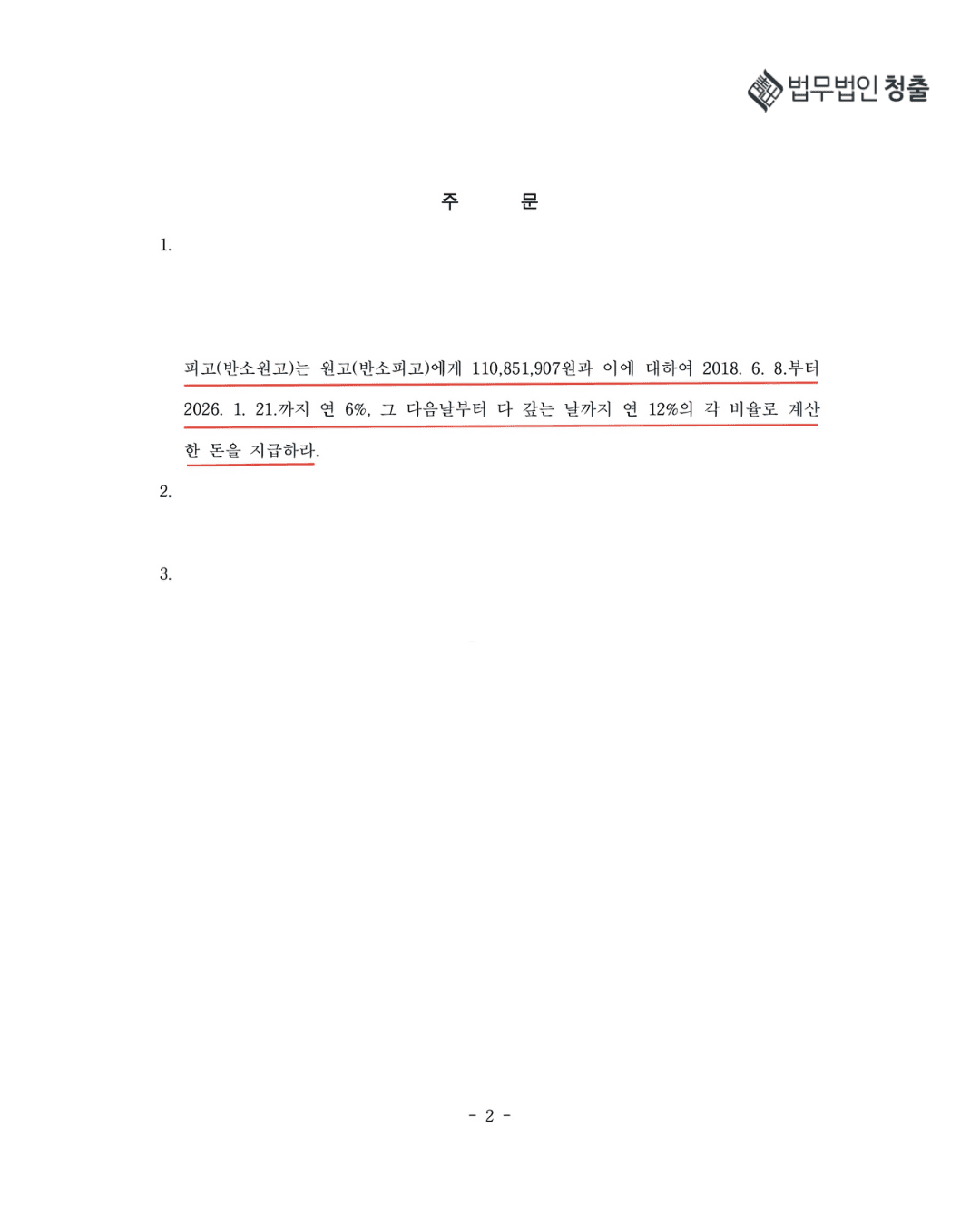
The appellate court acknowledged the client's delay damage claim of 144,072,000 won and defect damages claim of 159,760,593 won, subsequently offsetting these against the main construction payment claim to confirm the unpaid construction payment balance of 110,851,907 won. The order was also modified to cancel the excess portion of the first instance ruling.
5. Significance (Meaning of this Case)
This case illustrates that even in unfavorable circumstances where the major issue of design changes (contract drawings) is maintained in the appellate court, (i) the correction of factual misapprehensions regarding the ‘fairness and timing’ that underlie the determination of defects and (ii) reconstructing the occurrence and attribution of delay damages by linking them with the ‘background of the design change dispute’, resulted in a significant reduction of the main claim amount.
In particular, in construction disputes, since the results of appraisals often serve as the fundamental basis for substantive judgments, this case holds significant practical meaning as it changed the conclusion by re-verifying the factual basis (priorities, pouring dates, etc.) underlying the appraisal, rather than merely accepting the appraisal opinions as they are.
Cheongchul Law Firm consists of attorneys from the country's top five large law firms, prosecutors, and legal teams from large corporations. Rather than one attorney, a team of specialized lawyers related to the case is organized to respond. Cheongchul provides comprehensive solutions for all aspects of business, focusing on ultimately achieving what clients desire beyond just resolving specific issues. If you need help achieving your goals, please feel free to contact Cheongchul.
Related work cases that are good to see together
Corporate advisory · Dispute
AI · Emerging Business
[Consultation] Advice on improper inducement of personnel under the Fair Trade Act
Corporate advisory · Dispute
[Consultation] Legal advice on reviewing a model contract for advertising agencies.
Fair Trade
[Consultation] Legal advice on whether there are any violations of the Fair Trade Act related to transactions with large corporate affiliates.


서울 강남구 테헤란로 403 리치타워 7층
Tel. 02-6959-9936
Fax. 02-6959-9967
cheongchul@cheongchul.com
개인정보처리방침
면책공고
© 2025. Cheongchul. All rights reserved