
1. Introduction
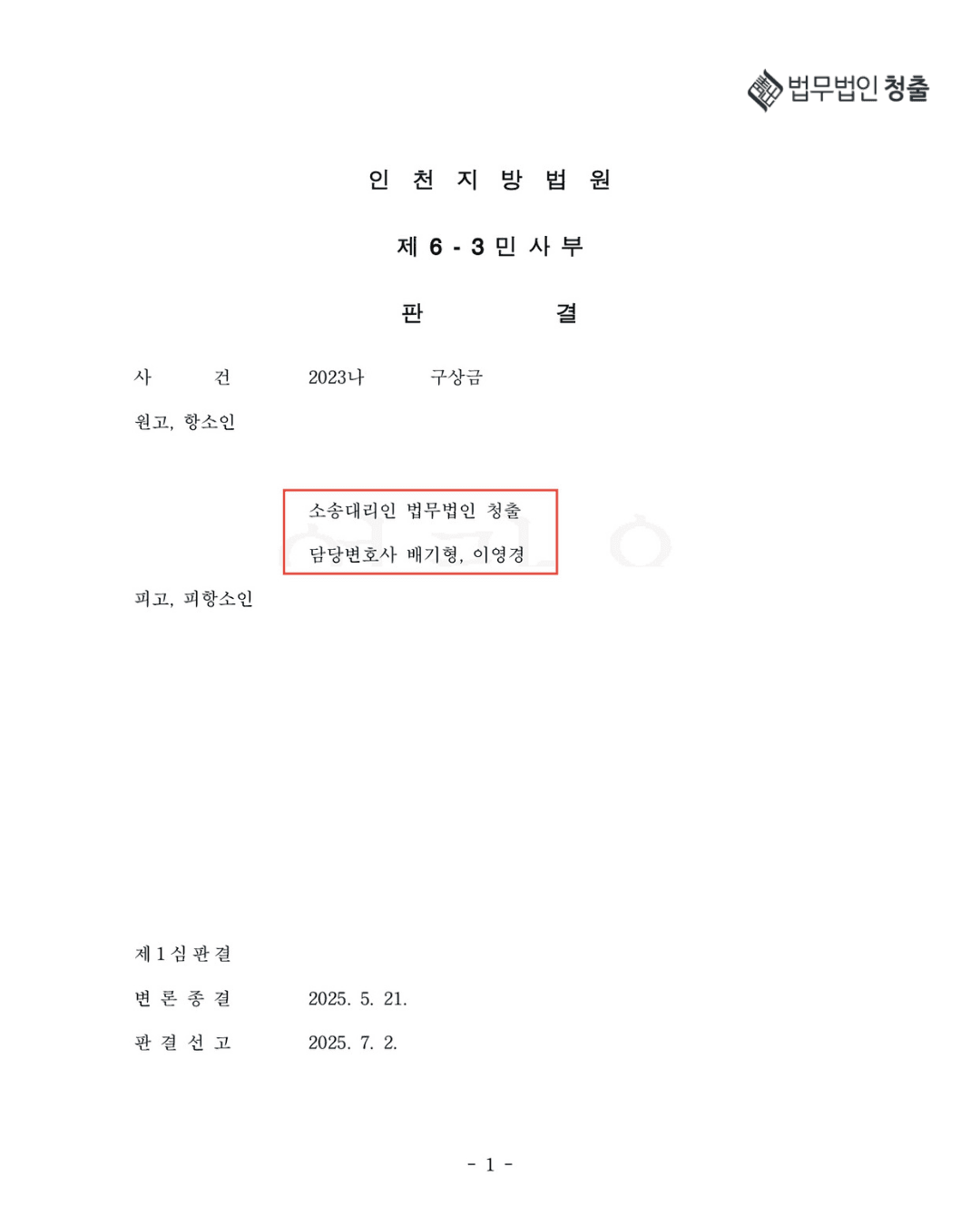
The law firm Cheongchul (attorney in charge: Bae Gi-hyung, Lee Young-kyung) conducted a claim for reimbursement against the other co-heirs and the heirs of the deceased co-heirs in a case where one of the co-heirs completely settled and paid the rental deposit obligation (inheritance debt) left by the deceased. They achieved a ruling fully in favor in the appellate court, expanding the scope of acceptance. The appellate court overturned the conclusion of the first instance ruling and accepted all the claims of Cheongchul.
2. Background of the Case
The deceased passed away while receiving rental deposits for several rooms in a building he was leasing, and the children became co-heirs with equal shares of 1/4 each. Later, when the contracts with the tenants were terminated or changed, a refund of the deposit became necessary. The client (one of the co-heirs) regularly returned the rental deposits whenever requested by the tenants, resulting in the other co-heirs being relieved of their portion of the deposit repayment obligation.
However, the co-heirs did not acknowledge the client’s return of the rental deposits and rejected the reimbursement claim. Consequently, the client filed a lawsuit against the other heirs for payment of reimbursement according to their respective shares, but lost in the first instance regarding a portion of the rental deposit.
Subsequently, the client entrusted Cheongchul with conducting the appellate lawsuit against the first instance ruling.
3. Legal Issues (Main Grounds and Issues of Cheongchul)
A. Establishing the Existence and Repayment of the “Rental Deposit Obligation as Inheritance Debt”
This case lost in the first instance due to simply asserting that 'the deposit was given', thus we had to rigorously connect the evidence to confirm: (i) whether a lease agreement in the name of the deceased existed, (ii) whether the refund obligation was inherited as an inheritance debt, and (iii) whether the client repaid the obligation (whether directly paid or settled indirectly during the tenant change process) through evidence-linking.
In particular, in several instances, the new tenant's payment of the deposit was settled not by paying the landlord (client) directly, but by transferring it to the previous tenant, and Cheongchul emphasized that this trading structure was essentially the same as “the landlord returning the deposit to the former tenant” (as a reduced performance of the obligation), leading to the court's recognition.
B. Defense Against the Allegation of “Forgery of Contracts and Related Documents”
The defendants argued that some lease agreements or documents proving payments were forged, but Cheongchul defended based on the presumption of authenticity of documents and the active burden of proof principles on the forgery claims. Furthermore, even if some contracts were prepared using seals after death in the form of 'tenant name change,' it was highlighted that the repayment was sufficiently recognized through the tenants' confirmation letters, receipts, and cash flow.
C. Rejection of Claims Denying Reimbursement Rights Based on Specific Legacy
The defendants claimed that since the client received the building as a specific legacy, there was no reimbursement right. However, Cheongchul argued that the rental deposit repayment obligation, as a monetary debt, is divided immediately upon commencement of inheritance, and in fact, related compulsory division cases have acknowledged the rental deposits as inheritance debt.
5. Significance (Meaning of this Case)
When inherited property is a income-generating real estate entangled with lease relationships, returning the deposit is the most frequent and significant dispute point among heirs. If it is not clearly organized


서울 강남구 테헤란로 403 리치타워 7층
Tel. 02-6959-9936
Fax. 02-6959-9967
cheongchul@cheongchul.com
개인정보처리방침
면책공고
© 2025. Cheongchul. All rights reserved