


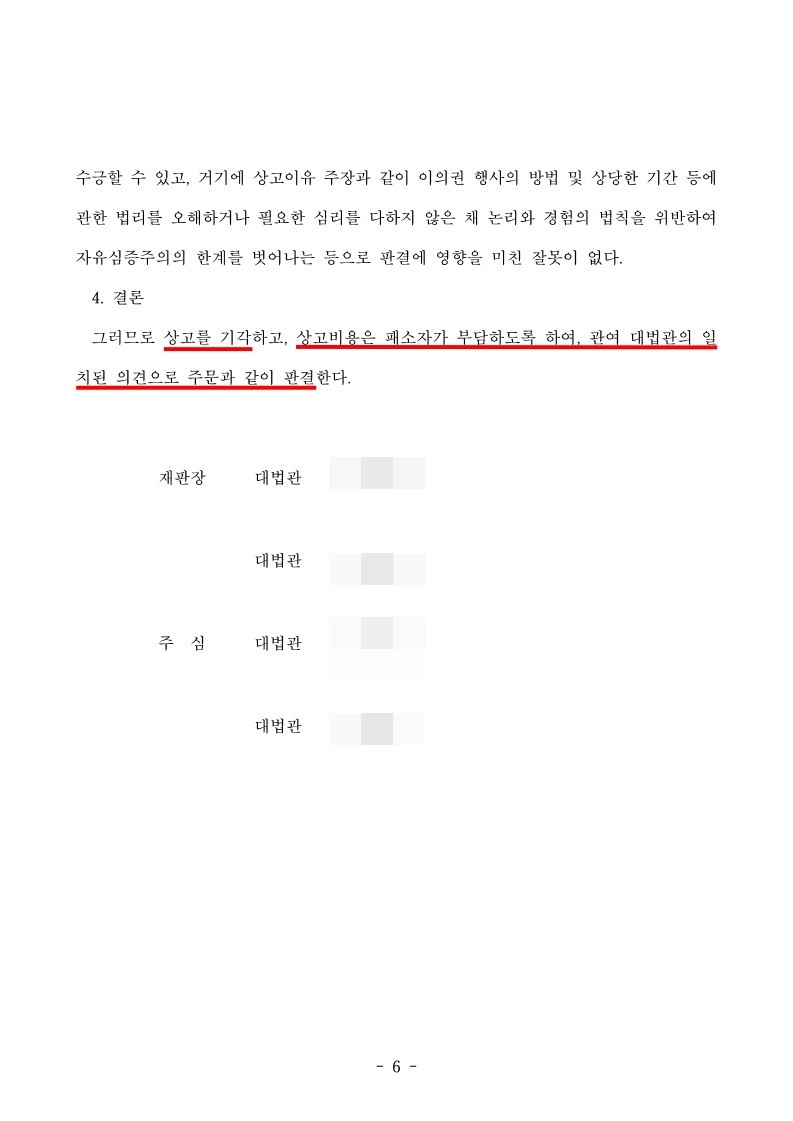
Law Firm Cheongchul (Attorney in charge: Park Jong-han, Bae Gi-hyung) represented the 5th largest company in Korea and obtained a Supreme Court ruling that recognized the right to claim the return of member deposits by asserting a new legal principle called “the right of objection to the inheritance of membership” in a situation where the ownership of a tourism business facility, a resort, was transferred through auction.
Article 8, Paragraph 2 of the Tourism Promotion Act stipulates that the person who takes over a tourism business facility shall inherit the status of the tourism business operator, and accordingly, the membership relationship with existing members who have contracted with the tourism business operator (the rights and obligations agreed upon with members) shall also be inherited.
The client entered into a membership contract for the resort sold by Company A in connection with the use of an anonymous golf course usage right, during which the other party provided joint surety for Company A's obligation to return the member deposit to the client. As Company A’s resort was auctioned, the client applied for a confirmation judgment on the rehabilitation claim against Company A and subsequently demanded that the other party fulfill their joint surety obligation for the member deposit return obligation, carrying out enforced execution on the other party’s property based on the joint surety claim.
In response, the other party claimed that, in accordance with the provisions of the Tourism Promotion Act, the membership relationship between Company A and the client was inherited by the successful bidder of the auction, thus they were no longer recognized as having joint surety responsibility, and filed a lawsuit to dispute the enforced execution.
Law Firm Cheongchul emphasized the following points in the Supreme Court appeal, and the Supreme Court accepted Cheongchul's opinion, ruling a new legal principle regarding “the objection right of members regarding the inheritance of the status of tourism business operators under Article 8, Paragraph 2 of the Tourism Promotion Act.”
Article 8 of the Tourism Promotion Act is a special provision intended to protect the interests of members despite changes in the business entity for those who take over the tourism business or acquire significant parts of the tourism business facility.
In light of the principle that the takeover of a contract for the purpose of inheriting the status of the contracting parties requires the agreement of both the transferor and the transferee regarding the contract status and the consent or approval of the other parties, a member should be recognized as having the right to choose whether to accept the inheritance of the status of the tourism business operator, irrespective of their will.
Therefore, members who do not wish to inherit the status of the tourism business operator can escape the binding nature of the membership contract by raising an objection within a considerable time after becoming aware of the transfer of the tourism business or the acquisition of significant parts of the tourism business facility, and it should be deemed that the obligation to return the admission fee to the existing tourism business operator does not disappear, which also applies in cases where there are guarantors of the return obligation.
When a member of a tourism business facility exercises their right of objection regarding the succession of the legal relationship under the membership contract, the legal relationship between that member and the existing tourism business operator should be regarded as continuing and not being extinguished from the start.
When a member exercises their right of objection regarding the succession of the status of the tourism business operator under Article 8, Paragraph 2 of the Tourism Promotion Act, such exercise of the right does not necessarily require special form or procedure; if the intention to be released from the binding nature of the succeeding legal relationship can be objectively recognized on the premise that the membership contract relationship with the existing tourism business operator is maintained, this can be considered as an exercise of the right of objection.
This case is significant in that, despite the existence of a previous unfavorable Supreme Court ruling on similar factual circumstances, Cheongchul meticulously argued for a new legal principle of “the right of objection of members regarding the succession of membership,” and the Supreme Court accepted Cheongchul's reasoning in its judgment, achieving a complete victory (dismissal of the appeal) against a large law firm ranked in the top 10 in Korea.
If you need strategic solutions for legal disputes, Law Firm Cheongchul will assist you.

Related work cases that are good to see together
Construction & Real Estate
Corporate advisory · Dispute
[Lawsuit] Appeal victory regarding the claim for the deposit of the guarantor of the resort membership contract linked to golf course usage rights.
Corporate advisory · Dispute
Construction & Real Estate
[Lawsuit] Entire victory in the lawsuit regarding the deposit claim for the golf club membership agreement.
Corporate advisory · Dispute
[Lawsuit] Achieved a new Supreme Court ruling recognizing the member's right to objection under the Tourism Promotion Act concerning the golf club membership deposit, resulting in a complete victory in the appeals trial.


서울 강남구 테헤란로 403 리치타워 7층
Tel. 02-6959-9936
Fax. 02-6959-9967
cheongchul@cheongchul.com
개인정보처리방침
면책공고
© 2025. Cheongchul. All rights reserved