

1. Introduction
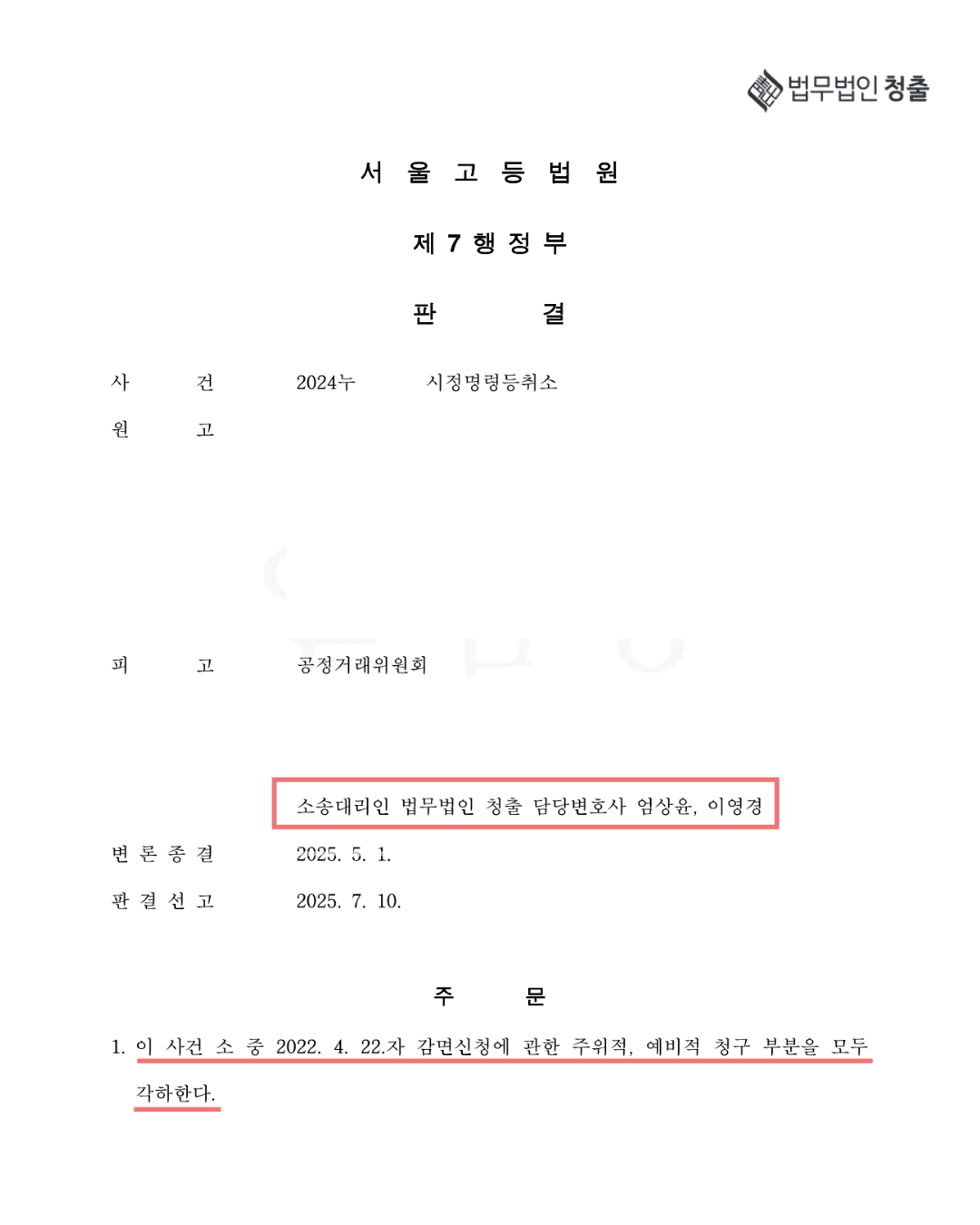
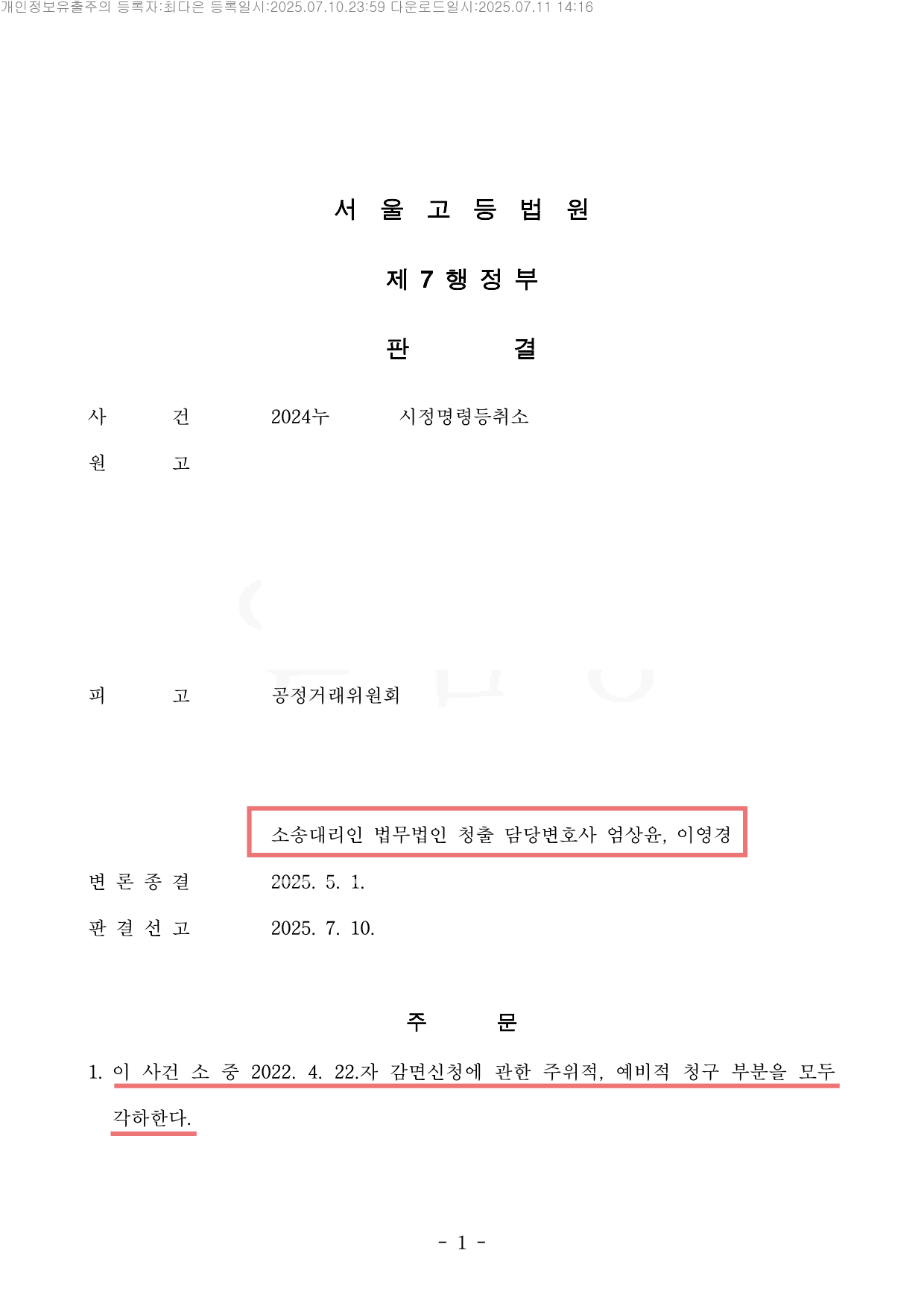
The law firm Cheongchul (lead attorneys: Eom Sang-yoon, Lee Young-kyung) achieved a complete victory in the cancellation lawsuit for the corrective order and the order for the payment of fines filed by a major domestic furniture company (the plaintiff) against the Korea Fair Trade Commission (the defendant), successfully rejecting all claims of the plaintiff and getting a judgment in favor (dismissal and denial of the plaintiff's claims).
This case involved the plaintiff, who retained a large law firm (Hwa Woo), strongly asserting the 'leniency based on voluntary reporting' and the 'unfairness of the fine calculation.' However, Cheongchul successfully led to a dismissal judgment regarding the plaintiff's 'rejection ruling' by arguing the legal principles related to the requirements for leniency.
2. Background of the case
The plaintiff (the furniture company) colluded with other furniture companies on the bid prices and winning candidates for the special furniture bids commissioned by the construction company between 2017 and around 2019. As a result, the Korea Fair Trade Commission imposed a fine amounting to hundreds of millions of won along with a corrective order on the plaintiff.
The plaintiff filed a lawsuit in response, presenting two main arguments as follows:
First, since the plaintiff submitted a comprehensive voluntary report (leniency) including these bids to the Fair Trade Commission as a priority, the collusion in this case should also be included as a subject for fine exemption. Therefore, the Fair Trade Commission’s failure to make any determination regarding the plaintiff's leniency application constitutes a de facto rejection and should be canceled (primary claim), or confirmed as an unlawful omission (secondary claim).
Second, even if it were not subject to leniency, applying a higher standard rate (3%) for imposing fines compared to similar cases (the Daewoo Construction case) constitutes a deviation and abuse of discretion by the Fair Trade Commission regarding the imposition of fines.
3. Legal issues (Key basis and points of contention raised by Cheongchul)
The key issues in this case are (i) whether leniency applications can be recognized even if no evidence was submitted for individual collusions after submitting a comprehensive leniency application regarding several joint acts within the correction period, and (ii) whether there exists an abuse of discretion in determining the standard rates for imposing fines by the Fair Trade Commission.
Regarding the first issue, the Fair Trade Commission regarded that there was no application for leniency in regard to some of the joint acts due to the absence of evidence submission, thereby not making any determination on the plaintiff's application for leniency. If this judgment is lawful, then the plaintiff’s claims should be dismissed since they pertain to a non-existent ruling.
In this regard, the law firm Cheongchul strongly asserted that there was no existence of the plaintiff's application for leniency.
(i) Failure to meet statutory requirements: Under Article 44 of the 'Monopoly Regulation and Fair Trade Act' (hereinafter referred to as the "Fair Trade Act") and Article 51 of its enforcement decree, those seeking leniency must submit an application containing an outline of the joint action, evidence necessary to substantiate the joint action, and a list of evidence to the Fair Trade Commission. According to the 'Operating Guidelines for the Leniency System regarding Respondents of Unfair Joint Actions' (hereinafter referred to as “Leniency Guidelines”), it is exceptionally allowed for those who have special circumstances preventing them from submitting evidence at the time of application to later provide corrections through document submissions.
(ii) Absence of evidence submission: The plaintiff did not submit evidence pertaining to the joint act within the correction period, and the acknowledgment of the collusion involvement of plaintiff's employees was made only after the correction deadline.
(iii) Existence of other businesses that submitted evidence: There were businesses that provided specific evidence related to the joint act before the plaintiff.
Furthermore, Cheongchul contended that the imposition of fines on law violators falls under the discretionary powers of the Fair Trade Commission (Supreme Court ruling 2009Du15005, etc.), and that the fact there were no benefits obtained from collusion does not render the imposition of fines unlawful (Seoul High Court ruling 2015Nu32133, etc.), thus maintaining that the standard rate applied in this case cannot be viewed solely as a deviation or abuse of discretion just because it is higher than in related cases.
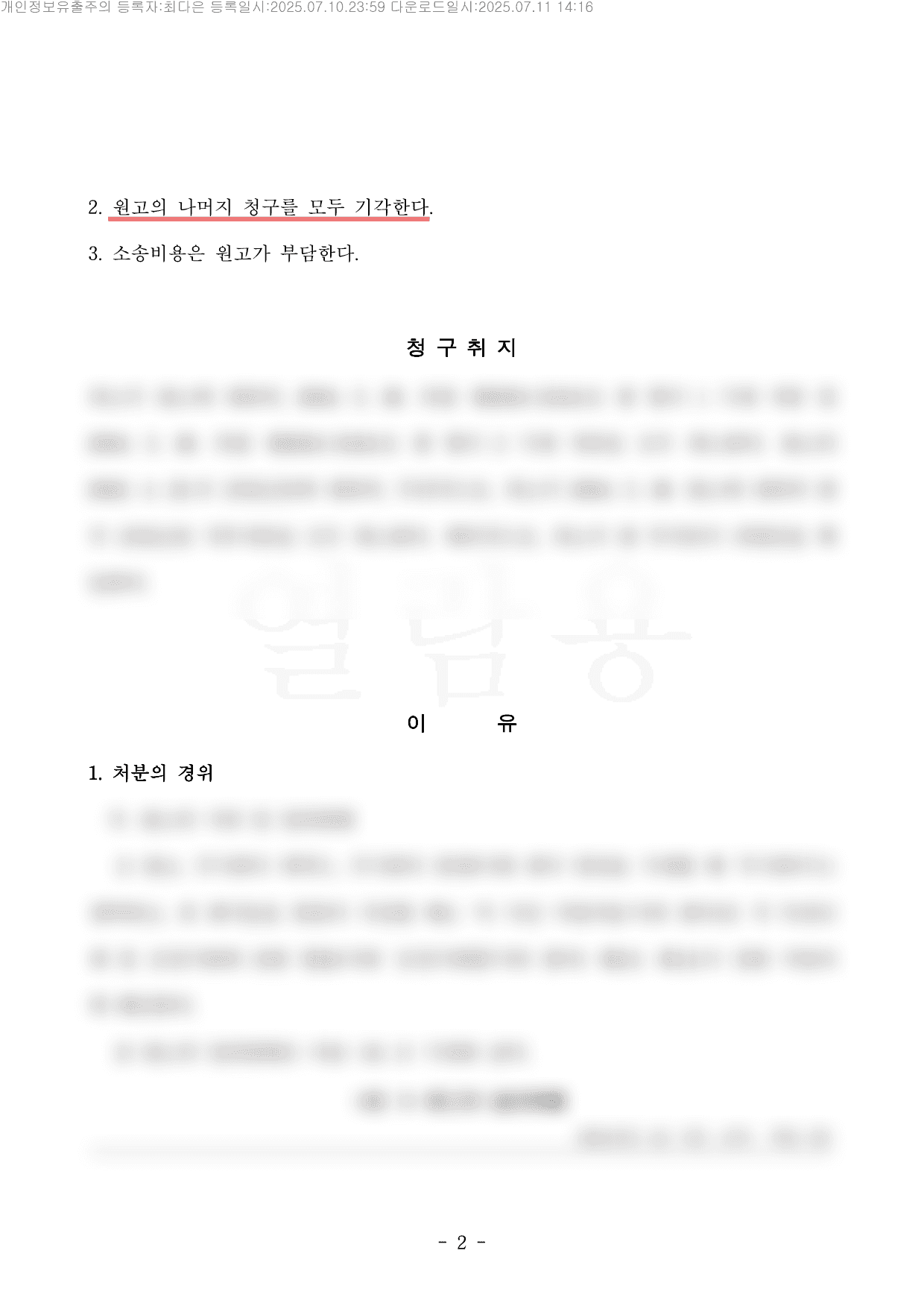
As a result, the court accepted most of Cheongchul's arguments, dismissing the lawsuit regarding the plaintiff's request for cancellation of the rejection ruling for the leniency application and confirming the illegality of non-action, while denying the plaintiff’s request for cancellation regarding the imposition of fines.
4. Significance (Meaning of this case)
The Fair Trade Commission has consistently maintained the practice that if no specific materials are submitted to prove the collusion act in voluntary reporting for leniency applications, 'the application itself is nonexistent.' This judgment is significant as it is the first time the legality of this practice has been confirmed by the court, and it also suggests important considerations for businesses when applying for leniency.
Typically, voluntary reporting leniency applications only contain a summary of the collusion act due to time constraints, while the specific details of the act and related evidence are often submitted later for corrections. The Fair Trade Commission's 'Operating Guidelines for the Leniency System regarding Respondents of Unfair Joint Actions' stipulate that corrections must be made within the designated timeframe.
Thus, when making voluntary reports concerning several joint acts, it is necessary to confirm whether there are any omissions of evidence regarding the joint acts during the correction process, and whether the previously submitted application meets the formal requirements under the law.
 |  |
The law firm Cheongchul is composed solely of attorneys from top-tier law firms, prosecution offices, and corporate legal teams in Korea. Instead of relying on a single attorney, Cheongchul forms teams of specialized attorneys in relevant fields to respond effectively. Cheongchul provides comprehensive legal consulting that focuses not just on resolving specific issues but also on delivering overall solutions for businesses, ultimately aimed at achieving the client's goals. If you need assistance in achieving your objectives, please feel free to contact Cheongchul.
Related work cases that are good to see together


서울 강남구 테헤란로 403 리치타워 7층
Tel. 02-6959-9936
Fax. 02-6959-9967
cheongchul@cheongchul.com
개인정보처리방침
면책공고
© 2025. Cheongchul. All rights reserved