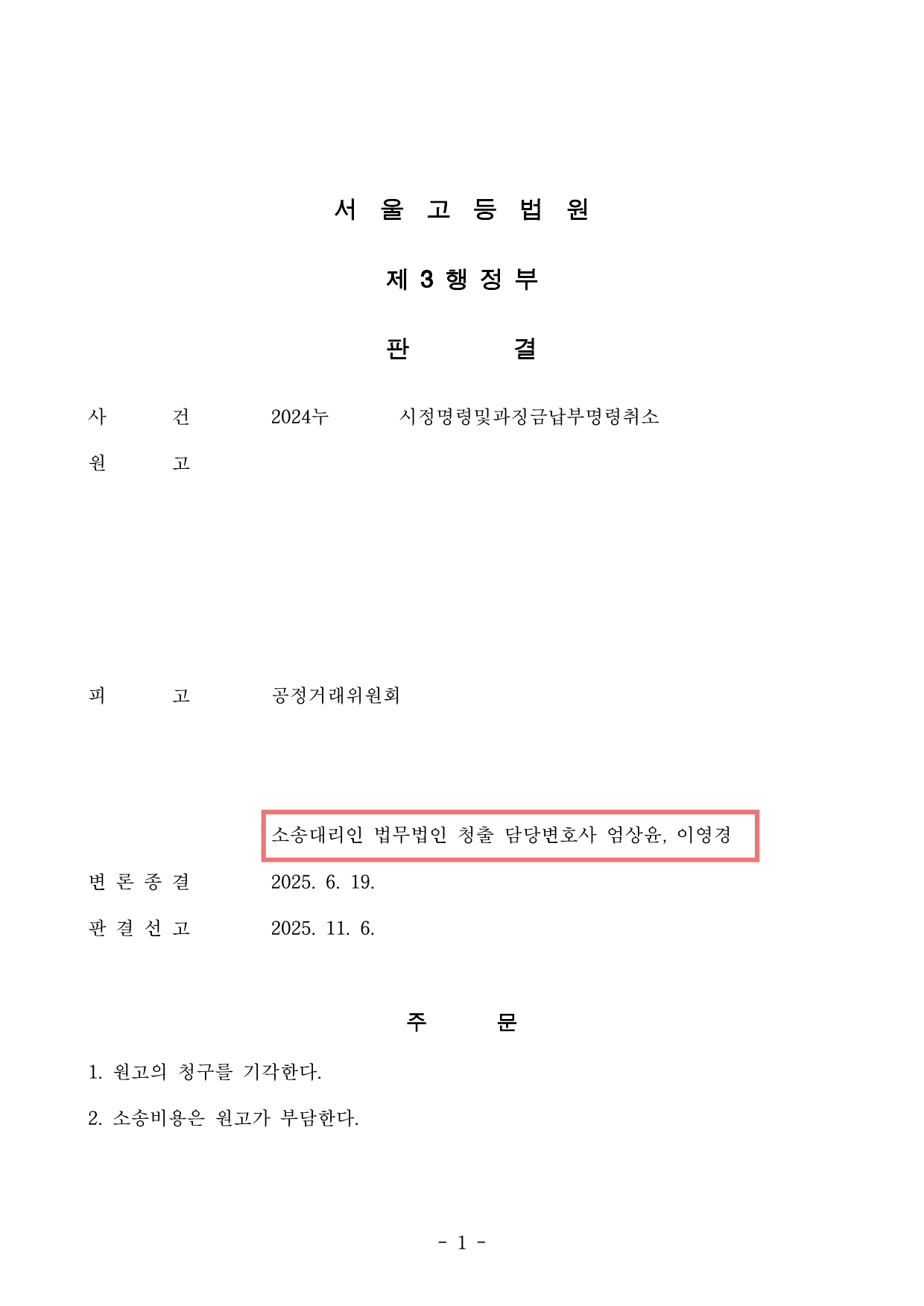


1. Introduction (Summary of Results)
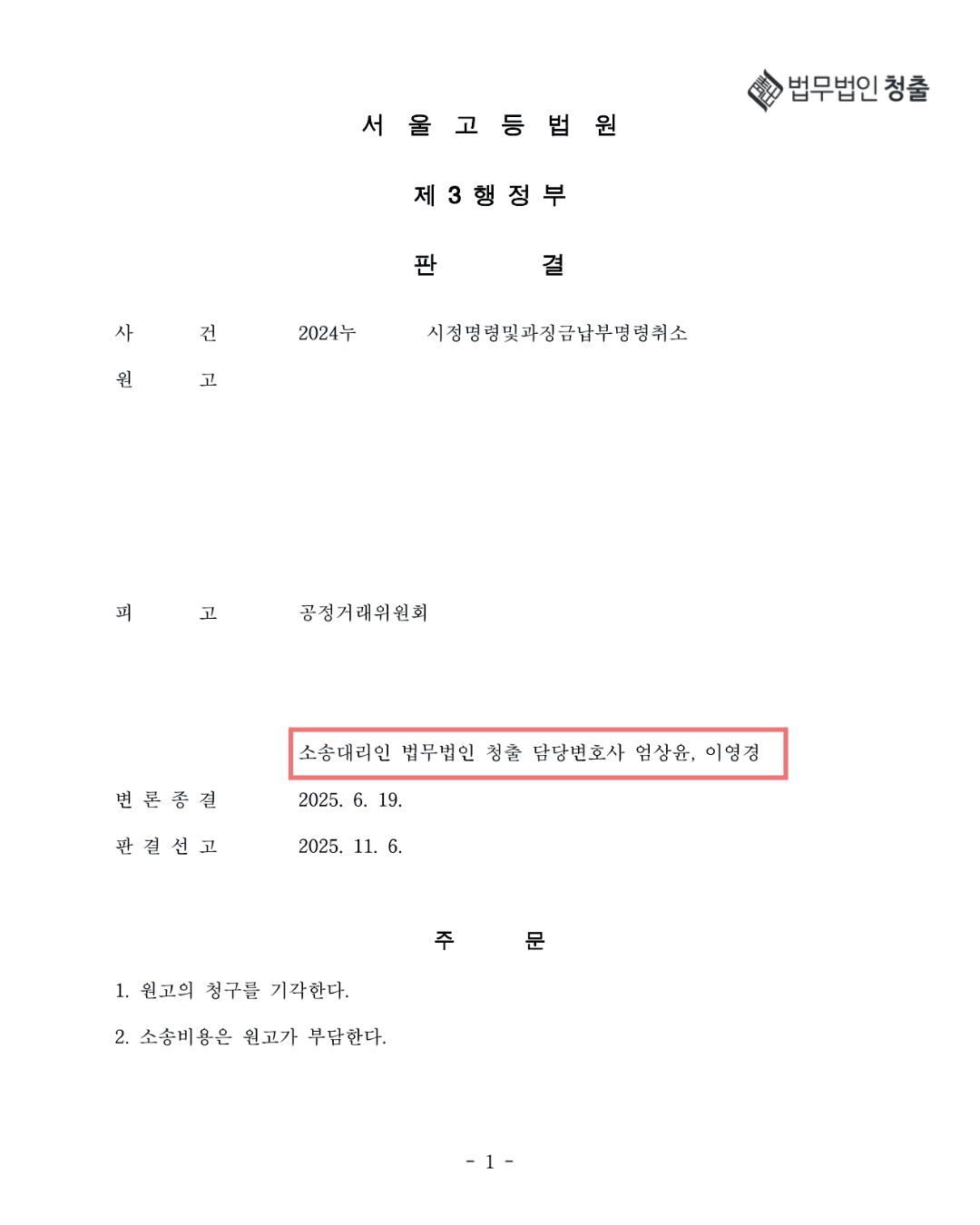
The law firm Cheongchul (Lead Attorneys: Eom Sang-yun, Lee Yeong-gyeong) achieved a complete victory in the lawsuit for the cancellation of the corrective order and penalty payment order filed by the plaintiff, an automotive parts manufacturer, representing the Fair Trade Commission (Defendant).
In this case, the plaintiff appointed a large law firm and waged a fierce legal battle regarding ① the technical relevance of the 'public law plan' and ② the unfairness of imposing a unilateral confidentiality obligation, but Cheongchul refuted all of the plaintiff's claims through legislative intent of the subcontract law and technical analysis. This ruling is significant as it reaffirms the court's criteria for the 'scope of technical materials' and the 'unfairness of unilateral confidentiality agreements' in subcontracting transactions.
2. Background of the Case
The plaintiff is a primary vendor that manufactures automotive body parts and supplies them to completed vehicle manufacturers, and engaged in the following actions while entrusting parts manufacturing to subcontractors.
① Failure to provide written documents when requesting technical material: When requesting the public law plan required for part production from subcontractors, the plaintiff did not provide a written document with legal required information (purpose of request, compensation, rights attribution).
② Setting unfair special terms: A clause was established through the basic contract and confidentiality agreement that unilaterally imposes confidentiality obligations only on subcontractors.
In response, the Fair Trade Commission (Defendant) determined violations of Article 12-3(2) (failure to provide written documents) and Article 3-4(2)(4) (setting unfair special terms) of the subcontract law, leading to the imposition of a corrective order and penalties, to which the plaintiff filed a lawsuit for cancellation.
3. Legal Issues (Main Grounds and Issues of Cheongchul)
The plaintiff argued as follows regarding the key issues of this case.
① Whether the public law plan prepared by the subcontractor is a technical material protected under the subcontract law.
Absence of Independent Economic Value: The public law plan is basic information that anyone can obtain via internet search or merely replicates the drawings provided by the plaintiff, thus lacking independent economic value.
Lack of Technological Independence: The 'technical material of the subcontractor' as referred to in the text of the subcontract law means materials that contain the subcontractor's unique technology, but this material is for approval by the plaintiff and includes their technology, thus not being a subject of protection.
Lack of Confidentiality Management: The content of the public law plan is widely known information within the industry, and since the subcontractor did not notify or label it as 'confidential' to the plaintiff, it cannot be deemed to have confidentiality management.
② Whether imposing confidentiality obligations only on subcontractors constitutes an 'unfair special term.'
Denial of Contract Content: Sending a ‘development request’ is merely a notification of a fact or a simple offer, and the ‘confidentiality agreement’ is simply a unilateral action by the subcontractor, thus it cannot be regarded as an agreement based on mutual consent.
Expiration of Investigation Period: The determination of whether there are unfair special terms should be based on the timing of the initial basic contract and, since already 7 years have passed, the investigation period has lapsed.
Illegality of the Guidelines on Unfair Special Terms: The Fair Trade Commission's notification that considers the imposition of confidentiality obligations only on subcontractors as unfair special terms exceeds the delegated range of the original law and is thus invalid.
In response, Cheongchul argued that the public law plan corresponds to technical materials protected under the subcontract law and that imposing a unilateral confidentiality obligation on subcontractors constitutes an unfair special term. The court mostly accepted Cheongchul's arguments and dismissed the plaintiff's claims.
① The public law plan corresponds to technical materials containing the know-how of the subcontractor.
The public law plan contains not only simple shapes but also detailed information such as 'types of public law, sequences, using equipment, press pressure, precautions' that is specifically tailored to the equipment and experience of the subcontractor, reducing trial and error in product development and costs, thus clearly possessing independent economic value.
The subcontract law does not limit technical materials to 'the unique technology of the subcontractor.' Even if the public law plan is drafted based on the plaintiff's drawings, if it materializes the manufacturing know-how of the subcontractor, it can be regarded as the subcontractor's technical material.
The subcontractors stored the relevant material on access-controlled servers and managed it confidentially. Most importantly, the fact that the plaintiff required the subcontractor to create a 'confidentiality agreement' serves as evidence that the plaintiff recognized this material as confidential.
② The imposition of unilateral confidentiality obligations clearly constitutes an unfair special term.
A contract is formed for each order based on individual development requests after the conclusion of the basic contract, and the guidelines for fair subcontracting transactions stipulate that 'in determining the timing of subcontracting contracts, the time of the individual contract based on the order form, rather than the basic contract, is used.'
The confidentiality agreement also forms the content of the subcontracting transaction. The subcontractor cannot refuse the plaintiff's request (confidentiality agreement) to maintain the transaction, therefore it is substantially a 'contract condition' affecting the rights and obligations of the subcontractor.
It is fair trading practice for both parties to bear equal confidentiality obligations, and it is unfair for the plaintiff to impose confidentiality obligations only on the subcontractor despite receiving technical materials (public law plan) from them. The declaration of the unfair special term that imposes unilateral confidentiality obligations on the subcontractor can be considered to be within the delegated range of the subcontract law.
4. Significance (The Meaning of This Case)
This case was the first instance where the Fair Trade Commission sanctioned acts of setting unfair special terms related to the confidentiality obligations of technical materials after the establishment of the guidelines on unfair special terms.
This ruling is significant in that it reaffirms the recognized range of 'technical materials' under the Subcontract Law. The court clearly stated that even if the material is drafted based on the plaintiff's drawings, if it includes the subcontractor's unique equipment operation know-how or process orders, thus reducing trial and error and costs, it constitutes technical materials with independent economic value. This confirms that technical materials do not need to be limited to 'highly independent new technologies' and is likely to serve as an important criterion in similar future disputes.
Moreover, it should be noted that the court emphasized the 'substance' over 'form' in determining whether a special term is unfair. The court found that the 'confidentiality agreement' is indeed essential for maintaining trade, regardless of whether it is formally a unilateral action of the subcontractor, thus taking it as a substantial contract condition. Furthermore, the court clarified that imposing unilateral confidentiality obligations on the subcontractor while the plaintiff also receives technical materials violates the principles of fair subcontracting transactions and constitutes unfair special terms.
Through this, Cheongchul not only defended the legality of the decision by proving the difference between simple information and protectable know-how, but also achieved reaffirmation of the validity of the Fair Trade Commission's notification from the judiciary.
The law firm Cheongchul consists of attorneys from one of the top five law firms in Korea, prosecutors, and corporate legal teams, and is composed of specialized attorneys related to the case rather than just one attorney responding. Cheongchul provides comprehensive solutions for all aspects of business, focusing not only on solving specific issues but also on achieving the client's goals. If you need assistance in achieving your goals, please do not hesitate to contact Cheongchul.
Related work cases that are good to see together
Corporate advisory · Dispute
AI · Emerging Business
[Consultation] Advice on improper inducement of personnel under the Fair Trade Act
Fair Trade
[Consultation] Legal advice on whether there are any violations of the Fair Trade Act related to transactions with large corporate affiliates.
Fair Trade
[Lawsuit] Cancellation lawsuit for the fine on furniture manufacturers' collusion, completely won on behalf of the Fair Trade Commission.


서울 강남구 테헤란로 403 리치타워 7층
Tel. 02-6959-9936
Fax. 02-6959-9967
cheongchul@cheongchul.com
개인정보처리방침
면책공고
© 2025. Cheongchul. All rights reserved