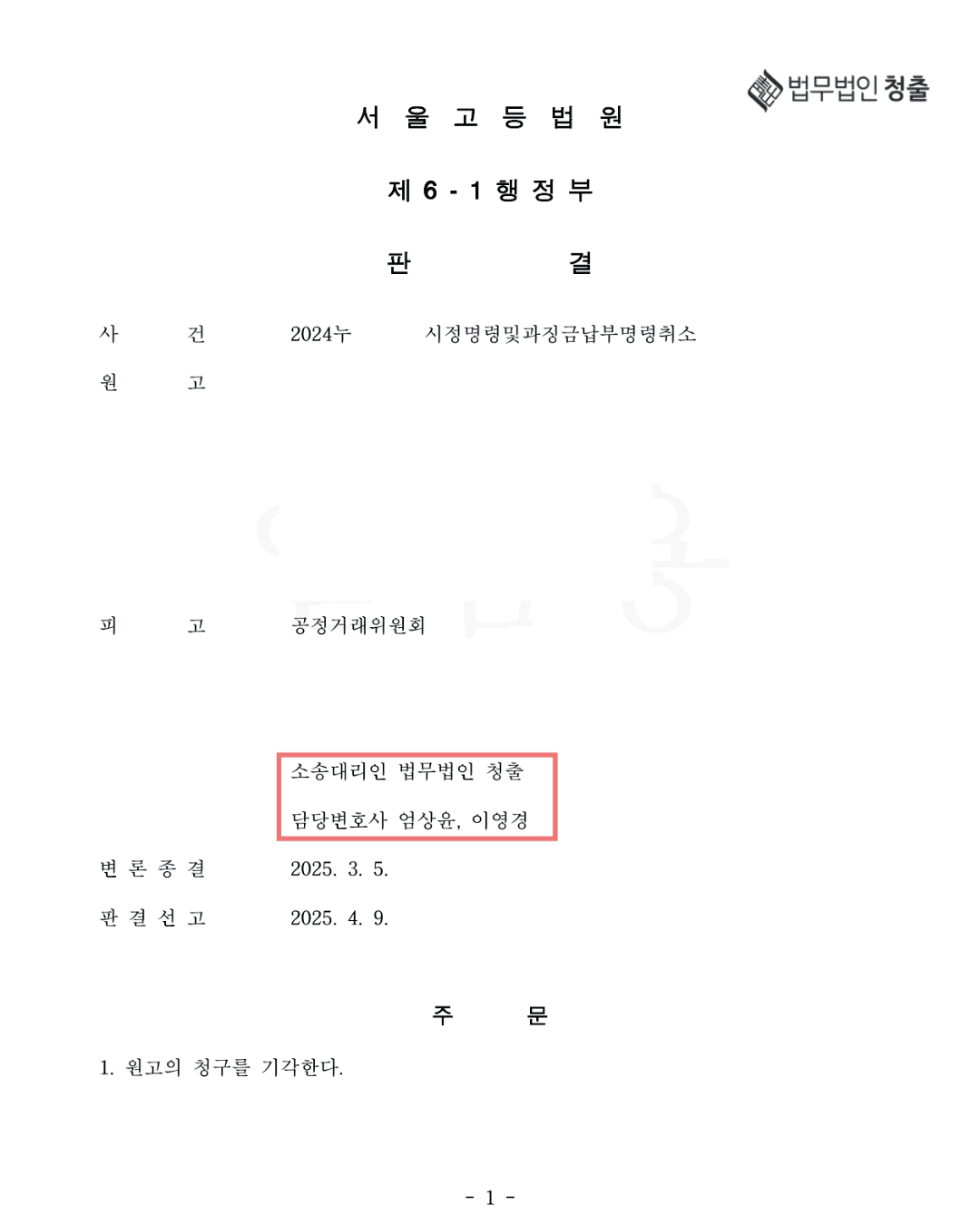


The law firm Cheongchul (Responsible Attorneys: Eom Sang-yun, Lee Young-gyeong) succeeded in representing the defendant, the Fair Trade Commission, in a lawsuit filed by a major domestic furniture company (the plaintiff) against the Fair Trade Commission (the defendant) seeking the cancellation of corrective orders and monetary penalty payment orders, obtaining a court ruling that dismissed all claims by the plaintiff and declared the defendant victorious (plaintiff's claims rejected).
In this case, the plaintiff, who appointed a major domestic law firm (Kwangjang), strongly argued against the existence of 'non-existence of an agreement (simple exchange of information)', 'non-existence of competitive restrictions', and 'unfairness of penalty calculation', but Cheongchul derived a dismissal ruling against the plaintiff's claims through legal arguments based on the meaning of unjust collusion under the Fair Trade Act and the expertise accumulated through numerous cases representing the Fair Trade Commission.
1. Background of the Case
The plaintiff (furniture company) colluded with other furniture companies on bid prices and prospective bidders in special furniture bids issued by a specific construction company from 2013 to around 2022. In response, the Fair Trade Commission imposed a penalty of over 1 billion won on the plaintiff along with a corrective order.
The plaintiff contested this and filed a lawsuit, presenting three major arguments as follows:
First, the plaintiff argued that its actions with other furniture companies constituted mere information exchange through simple price sharing and did not amount to bid collusion, emphasizing that the contents of the agreement, the circumstances of the agreement, and the parties involved differed significantly, making it difficult to view them as a unified collusive act.
Second, the plaintiff claimed that in light of the fact that this bid was a designated competitive bidding process, the competitive restriction was low, and that the participating companies only passively engaged in collusion to maintain friendly relations with the issuer, asserting that there was no competition restriction.
Third, it was asserted that applying a high penalty rate (3%) compared to other similar cases (DaeWoo Construction case) constituted an abuse of discretion by the Fair Trade Commission regarding penalty imposition.
2. Legal Issues (Major Grounds and Issues of Cheongchul)
The core issues of this case are (i) whether actions of information sharing and designating prospective bidders in advance can be classified as unjust collusion under the Fair Trade Act, (ii) the criteria for determining a unified collusion, (iii) the criteria for judging competitive restrictions, and (iv) whether there is an abuse of discretion in the Fair Trade Commission's imposition of penalty rates.
Cheongchul strongly argued against the plaintiff's claims by meticulously analyzing the established Supreme Court jurisprudence and factual relations regarding all issues raised by the plaintiff, as follows:
Regarding the first issue, Article 19, Paragraph 1 of the former Fair Trade Act prohibits agreements between two or more businesses to unjustly restrict competition, based on the premise that such agreements include both explicit and tacit agreements (refer to Supreme Court decision 2016. 2. 18. 2013Du19004 etc.), Cheongchul argued and proved that there were agreements among the plaintiff and other businesses concerning prospective bidders and bid prices prohibited by Article 19, Paragraph 1, Item 8 of the former Fair Trade Act.
Regarding the second issue, it was asserted that if businesses reach agreements on the basic principles of unfair collaboration and continue to execute them over time, those agreements, even if differing in specific contents or members in some respects, should be regarded as a single collusion unless there are exceptional circumstances. This is based on Supreme Court precedents (refer to Supreme Court decision 2008. 9. 25. 2007Du3756, Supreme Court decision 2009. 1. 30. 2008Du16179 etc.). Cheongchul argued and proved that the plaintiff's actions constituted a continuous series of actions under a single objective should be considered as a unified collusion.
Regarding the third issue, it was pointed out that whether a collusion has 'competitive restriction' is to be judged individually by considering several factors such as the characteristics of the goods or services, the criteria consumers use for product selection, and the impact on competition among markets and businesses, referring to the judgment that considered the possibility of reduced competition in specific transaction sectors affecting price, quantity, quality, and other transaction conditions (refer to Supreme Court decision 2013. 11. 14. 2012Du19298 etc.). It was argued and proved that the collusion had a likely impact on the determination of bid prices and other transaction conditions.
Regarding the fourth issue, it was stated that the imposition of penalties on violating businesses constitutes a discretionary action by the Fair Trade Commission (refer to Supreme Court decision 2009Du15005), asserting that just because there was no gain from collusion, the penalty disposition cannot be deemed unlawful (refer to Seoul High Court decision 2015Nu32133), thus maintaining that just because the penalty rate applied in this case is higher than in related cases does not imply an abuse of discretion.
In response, the court accepted Cheongchul's arguments and dismissed all of the plaintiff's claims against the corrective order and monetary penalty payment orders.
3. Significance (The Meaning of This Case)
This ruling has significant implications as it confirms that sanctions can be imposed on a case-by-case basis for bid collusion while also verifying that actions of information sharing and bids themselves may be classified as unjust collusion prohibited by the Fair Trade Act.
Therefore, when the counterparty is proceeding with an order through bidding, the companies participating need to implement checks and measures for legal compliance from their operational departments to ensure they do not fall under collusion.
The law firm Cheongchul is composed of attorneys from the top five major law firms in the country, the prosecution, and the legal teams of large corporations, with a team of specialized attorneys in relevant fields rather than a single attorney handling cases. Cheongchul provides comprehensive solutions that address overall business issues rather than just resolving specific points, focusing on achieving clients' desired outcomes. If you need assistance in achieving your goals, please do not hesitate to contact Cheongchul.
Related work cases that are good to see together
Fair Trade
[Lawsuit] Cancellation lawsuit against warning disposition for violation of the Advertising Law, fully won on behalf of the Fair Trade Commission.
Fair Trade
[Lawsuit] Cancellation lawsuit for the fine on furniture manufacturers' collusion, completely won on behalf of the Fair Trade Commission.
Fair Trade
[Fair Trade] Special Price Furniture Collusion Case Disposition Cancellation Lawsuit Victory


서울 강남구 테헤란로 403 리치타워 7층
Tel. 02-6959-9936
Fax. 02-6959-9967
cheongchul@cheongchul.com
개인정보처리방침
면책공고
© 2025. Cheongchul. All rights reserved