

This case is an incident introduced on the Supreme Court's website in the case summary as "Supreme Court Important Ruling on September 15, 2022".
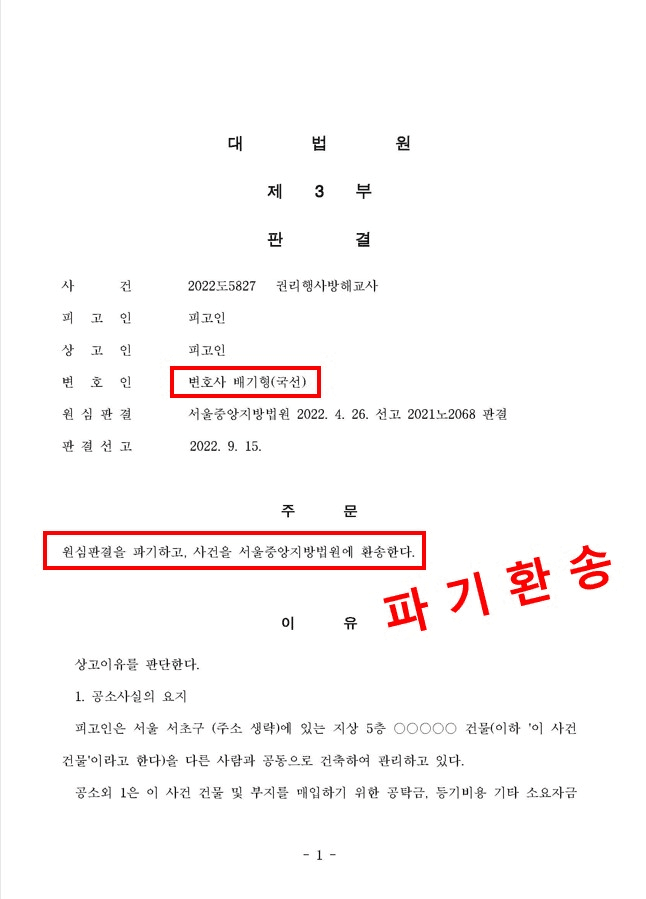
The appellant discovered a critical issue that was missed by both the prosecution and the defense in the first and second trials, and argued this as a reason for appeal in the Supreme Court, ultimately leading to a ruling that overturned and remanded the second trial's judgment.
In this case, the reason for appeal raised by the appellant regarding the "dependency of co-offenders" corresponds to a fundamental principle of criminal law, and the case well illustrates that having a solid understanding of legal principles and thoroughly analyzing the case can determine the outcome.
The law firm Cheongchul (Attorney in charge: Attorney Bae Gi-hyeong) defended the accused, who was charged with interference of rights for instructing his son to change the password of a digital door lock owned by the defendant, installed on the front door, to evict the victim residing in a building he managed. They successfully secured a Supreme Court ruling of not guilty.
In the first and second trials, the prosecution and the defendant fiercely contested whether the problematic digital door lock was owned by the defendant, and the second trial ultimately ruled that the digital door lock was considered as the 'his property' under Article 323 of the Criminal Act, resulting in a guilty verdict for the defendant.
The appellant prioritized a thorough analysis of the second trial's ruling and first examined the fundamental legal principles regarding the charge of interference with the exercise of rights and incitement. By noting that the second trial confirmed the digital door lock as the defendant's property, it was discovered that the act of changing the password of the digital door lock performed by the defendant's son made the digital door lock a 'property of another.' In this case, since the defendant's son could not be liable for interference of rights regarding someone else's property, the defendant's crime (incitement) could not be established based on the premise that the defendant’s son’s crime (principal) was recognized; this was raised as a reason for appeal.
The Supreme Court accepted all of the appellant's opinions, stating in the reasoning of the ruling that 'The establishment of the principal is part of the composition requirements of the incitement, and for the incitement to be established, the criminal act of the principal must be recognized.' Furthermore, it ruled that 'If the object taken, concealed, or destroyed is not his own property, the crime of interference with the exercise of rights cannot be established.' Thus, the Supreme Court issued a ruling of overturning and remanding the second trial's judgment on the grounds of not guilty against the defendant.
Related work cases that are good to see together
Corporate advisory · Dispute
AI · Emerging Business
[Consultation] Advice on improper inducement of personnel under the Fair Trade Act
Corporate advisory · Dispute
[Consultation] Legal advice on reviewing a model contract for advertising agencies.
Fair Trade
[Consultation] Legal advice on whether there are any violations of the Fair Trade Act related to transactions with large corporate affiliates.


서울 강남구 테헤란로 403 리치타워 7층
Tel. 02-6959-9936
Fax. 02-6959-9967
cheongchul@cheongchul.com
개인정보처리방침
면책공고
© 2025. Cheongchul. All rights reserved