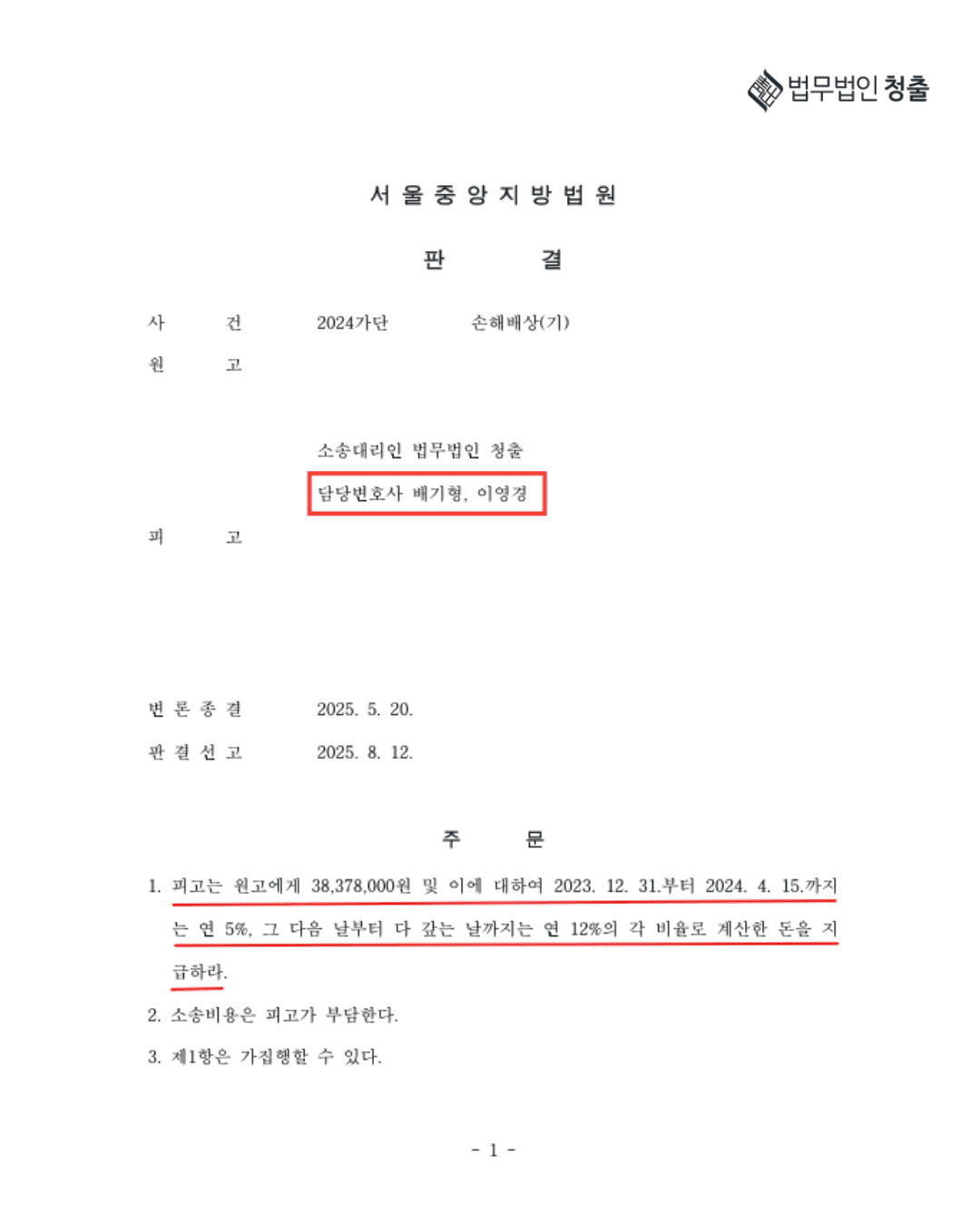

Cheongchul Law Firm (Attorney in charge: Bae Gi-hyung, Lee Young-kyung) successfully led a full judgment for damages equivalent to the deposit amount on behalf of the tenant in a case where the landlord obstructed the collection of the deposit by refusing to sign a lease agreement with a new tenant without justifiable reasons during the process of terminating the commercial building lease.
This case comprehensively addressed various justifications that a landlord could claim in cases of obstruction of deposit recovery, such as 'direct use' and 'remodeling plans', with Cheongchul determining that the circumstances justifying the obstruction of deposit recovery under the Commercial Building Lease Protection Act should be strictly judged.
1. Background of the Case
The client was a tenant operating a restaurant on the first floor of a commercial building located in Jung-gu, Seoul, and had been continuously operating under an implicitly renewed lease agreement for a long time. Subsequently, the new owner (landlord), who purchased the building, refused to renew the lease agreement on the grounds that they intended to change the building's use and remodel it for their direct use, continuously demanding the handover of the store.
In this situation, the client sought to facilitate a new tenant to recover the deposit before the lease termination and actually signed a deposit contract with a new tenant. However, the landlord refused to sign a lease agreement with the new tenant, ultimately leading the client to hand over the store without recovering any deposits. Consequently, Cheongchul Law Firm filed a claim for damages, seeing the landlord's actions as constituting obstruction of deposit recovery prohibited under Article 10-4 of the Commercial Building Lease Protection Act.
2. Legal Issues (Key grounds and issues of Cheongchul)
The core issues of this case are as follows:
First, whether the remodeling plan claimed by the landlord constitutes a ‘justifiable reason’ for refusing to enter into a lease with the new tenant (Article 10-4, Paragraph 1, Item 4 of the Commercial Lease Act, Article 10, Paragraph 1, Item 7, Sub-item a, Item 8). Cheongchul Law Firm emphasized that there were no specific demolition or reconstruction plans disclosed at the time of the lease agreement or during the succession of ownership and that the remodeling plan claimed by the landlord could hardly be considered as ‘demolition or reconstruction of all or most of the building’ as stipulated by the Commercial Lease Act.
Second, whether the landlord's claim of ‘not using for profit for more than 1 year and 6 months’ can be retroactively justified (Article 10-4, Paragraph 2, Item 3 of the Commercial Lease Act). In this regard, Cheongchul Law Firm pointed out, based on Supreme Court precedent, that unless the lease was refused on the grounds of this reason at the time of lease termination, the fact of not using the commercial building for profit for 1 year and 6 months cannot be recognized as a justifiable reason, and merely maintaining vacancy after the fact cannot serve as a justifiable reason.
Third, regarding the landlord's claim that the new tenant was merely a fake tenant, evidence was provided showing that there was absolutely no indication of fraud or conspiracy when considering the circumstances leading to the signing of the deposit contract, the testimony of the new tenant, and the mediation process.
The court accepted all these claims and concluded that the landlord's refusal to sign a new lease agreement constituted unjustified obstruction of deposit recovery.
3. Significance (Meaning of this case)
This case clearly reaffirms that if a landlord obstructs the opportunity to recover deposits by citing vague circumstances such as ‘direct use plans’ or ‘remodeling plans’, they cannot evade liability for damages. In particular, the determination of the existence of justifiable reasons must be strictly evaluated at the time of lease termination, and retroactive circumstances should not be easily taken into account.
Disputes related to lease agreements can vary greatly in amount and scale, and there are often different goals and purposes for litigation among the parties involved.
Therefore, Cheongchul Law Firm establishes case strategies centered on promoting the client's actual interests, not simply winning the litigation, and in this case, they also considered ways for the client to recover their deposits, taking into account the scale of the deposits.
If you are experiencing difficulties related to disputes over deposits or issues related to lease termination similar to this case, please feel free to contact Cheongchul Law Firm at any time.


서울 강남구 테헤란로 403 리치타워 7층
Tel. 02-6959-9936
Fax. 02-6959-9967
cheongchul@cheongchul.com
개인정보처리방침
면책공고
© 2025. Cheongchul. All rights reserved