

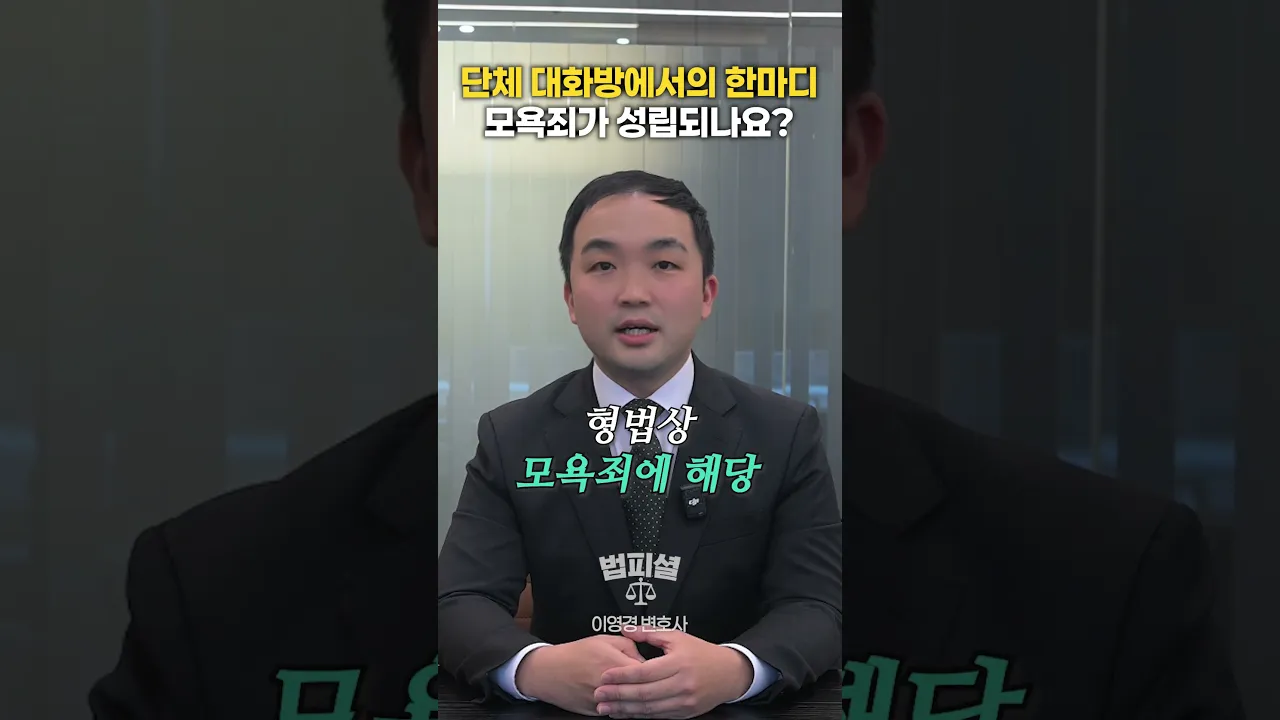
As smartphone usage has become commonplace, conversations in group chat rooms (called 'DanTalk' rooms), such as KakaoTalk, have become more active. However, did you know that a momentary comment made in a space with many people can be subject to criminal punishment? Today, the law firm Cheongchul will easily summarize the legal requirements and penalties for conflicts that arise in group chat rooms that may constitute defamation. Since a careless message can leave a record of conviction, please check the accurate legal knowledge through the contents below.
Hello. This is Law Firm Cheongchul.
The smartphone has become an essential item for modern individuals, along with the countless group SNS chat rooms that occur within it. It is a convenient channel for communicating with various people such as family, friends, and colleagues, but at times it can also become a venue for conflicts and disputes.
The video I am introducing today contains important information about whether such mistakes in group chats could legally be problematic.
■ The normalization of group chats: When trivial arguments become crimes
Many people think, "Could I really be punished just for having a fight in a chat room?" However, as pointed out in the video, insults or slanders in a group chat room with several people may not just end as a simple happenstance. If you insulted someone or used derogatory language during an argument, this constitutes a serious matter that can meet the elements of defamation under the criminal law.
■ The decisive reason why insults in group chats can be classified as 'defamation'
So, in what specific cases will a crime be established? Based on the video content, let’s analyze the key requirements.
1. Definition and penalty for defamation under Article 311 of the Criminal Code According to Article 311 of the Criminal Code, **"Whoever insults a person publicly"** shall be punished as follows.
Imprisonment or detention for up to one year
Or a fine not exceeding 2 million won
2. Key requirement: 'Public nature' The biggest issue in establishing defamation in group chats is the **'public nature'**. Public nature means the state of being perceived by unspecified or multiple people. In a group chat, aside from the parties involved—the one who used the insult and the victim—**third parties (other participants)** are also seeing the chat content. In the video, it’s explained that if there are other people in the space, it satisfies the condition of public nature since the situation can be perceived by many.
3. 'Specificity' of the victim Not every use of inappropriate language results in punishment. It must be clear **‘who the words are directed at.’** If the insult targets a specific person in a group chat or if the participants can ascertain who the words are directed towards in the context of the conversation, then specificity is also recognized, and the possibility of establishing defamation is very high.
In conclusion, it should be kept in mind that “if insults are directed at a specific person in a group chat and others see this,” one can be punished for defamation.
Legal disputes caused by momentary emotions, Law Firm Cheongchul is here to assist.
Online conversations are a legitimate form of social communication and carry legal responsibilities. If you are unjustly facing charges of defamation or suffering severe insult damage in a group chat, accurate legal assessment from the beginning is essential.
Law Firm Cheongchul provides optimal legal solutions by carefully analyzing the client’s situation. If you are struggling with related matters, do not hesitate to contact Law Firm Cheongchul.
Law Firm Cheongchul utilizes years of experience working with prosecutors and large law firms to identify investigative intentions and construct detailed defense arguments, ensuring that supplementary investigations can be an 'opportunity' for clients.
Don’t miss the timing, please respond together with Law Firm Cheongchul.
This post is written for the purpose of providing legal information, and legal judgments may vary depending on the specific circumstances.
Related work cases that are good to see together


서울 강남구 테헤란로 403 리치타워 7층
Tel. 02-6959-9936
Fax. 02-6959-9967
cheongchul@cheongchul.com
개인정보처리방침
면책공고
© 2025. Cheongchul. All rights reserved