
1. Introduction (Summary of Results)
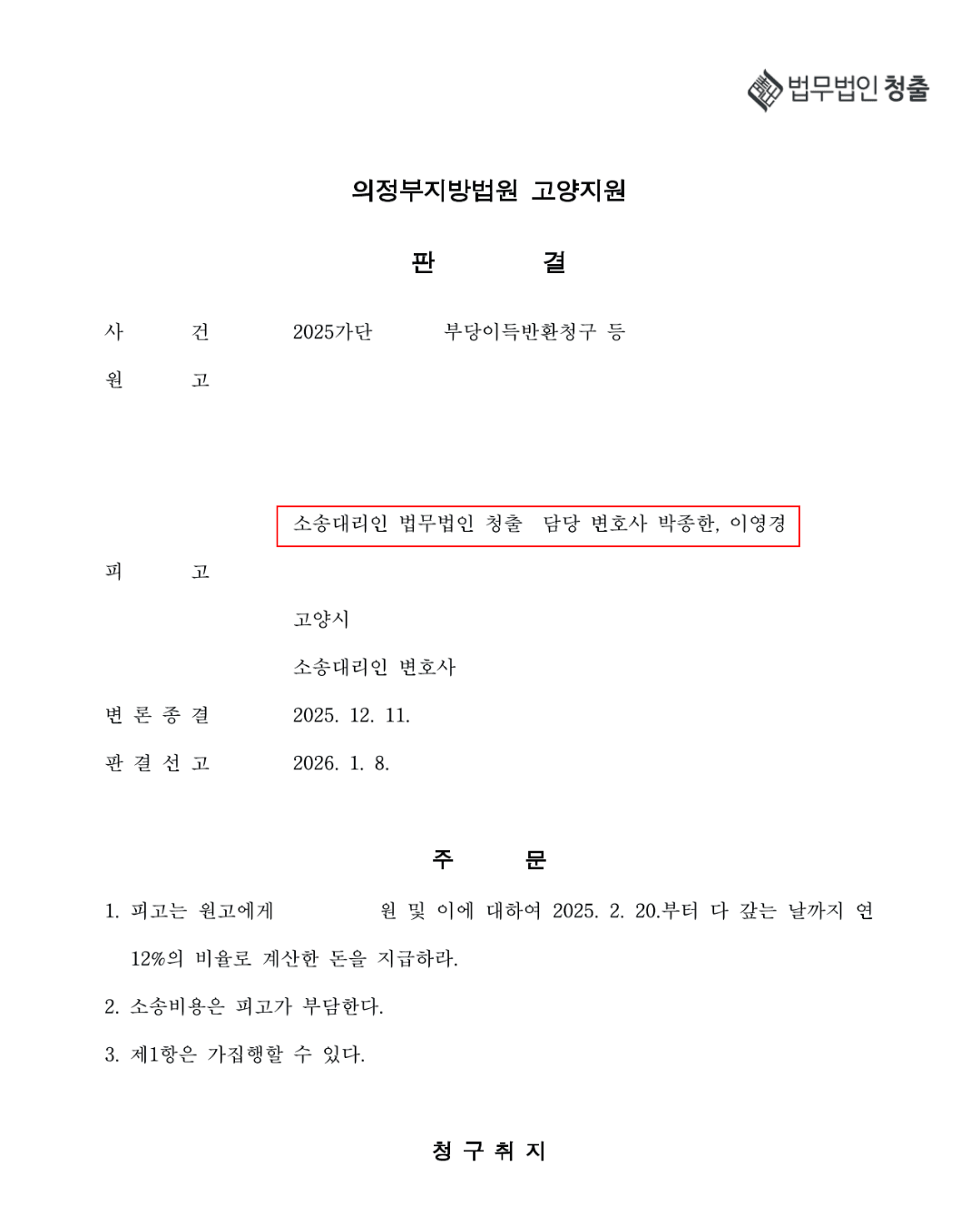
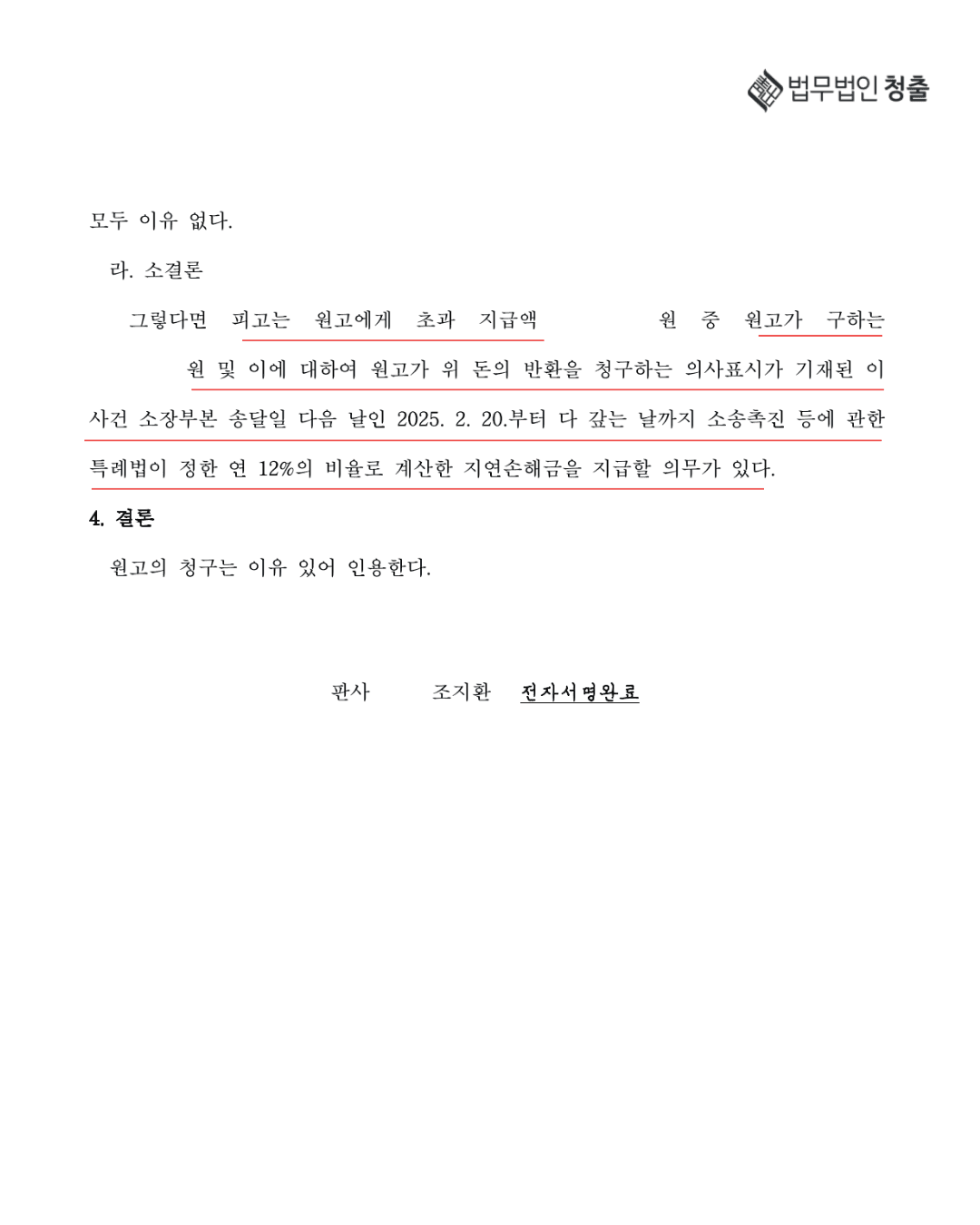
Chungchul Law Firm (Chief Attorneys: Park Jong-han, Lee Young-kyung) proved that the transaction in question pertains to a loan for consumption, allowing them to receive a favorable ruling (full judgment in favor of the plaintiff) in claiming the return of all excess interest payments made, despite the opposing party's assertion that, because it was an investment contract, there was no obligation to return the amount.
2. Background of the Case
The client drafted a promissory note when lending money to the opposing party, and subsequently paid all the requested interest amounts; however, the issue was that the interest rate far exceeded the limits set by the relevant laws. The country’s Interest Restriction Act stipulates a maximum limit on interest (currently 20% per annum), and the client had unwittingly paid interest exceeding this limit agreed upon between them and the opposing party.
Accordingly, Chungchul Law Firm filed a lawsuit on behalf of the client to claim the return of the excess interest amount paid.
3. Legal Issues (Key Grounds and Issues of Chungchul)
During the trial, Chungchul Law Firm demonstrated various circumstances showing that the financial transaction between the plaintiff (the client) and the defendant (the opposing party) only applied to a loan for consumption and could not be regarded as an investment contract.
In particular, regarding the criteria for distinguishing between investment and loan, they emphasized that (i) the promissory note between the plaintiff and the defendant assured the return of the full principal amount (guarantee of the principal), (ii) the plaintiff provided collateral like the establishment of a mortgage for the return of the amount to the defendant (whether the income generation was uncertain), (iii) the collateral provided through the mortgage was only terminated after the defendant received the full principal and interest from the plaintiff, and (iv) the lender, the defendant, was not familiar with nor involved in the business that the plaintiff was conducting.
The court accepted Chungchul's opinion that the financial transaction between the plaintiff and the defendant was a loan and that the maximum interest limit stipulated in the Interest Restriction Act applies; thus, it ruled that the defendant must return the interest amount received in excess of the maximum limit from the plaintiff, thereby fully accepting the client's claim for unjust enrichment (return of excess interest).
4. Significance (Meaning of This Case)
Recently, it has become common for the nature of past financial transactions to be questioned, not only between individuals but also between corporations, whether they are loans or investments. In cases like this, where excess interest payments are in question, whether the money received corresponds to a loan that must be returned or to an investment amount for which there is no obligation to return it is primarily at stake.
The plaintiff, who primarily seeks to recover the funds, claims that the transaction is a loan (loan for consumption), while the defendant, who believes there is no obligation to return the funds received, argues that the transaction is an investment.
Lower courts primarily base their distinction between investment and loan on the “guarantee of the principal” and “uncertainty of income generation,” and additionally examine the involvement of the party that received the funds in the business, ensuring that they do not merely rely on wording but thoroughly investigate the nature of the financial transaction. In essence, the court closely scrutinizes the facts regarding the financial transaction dynamics of both parties to determine its nature, necessitating precise evidence that supports the claims made.
 |  |
Chungchul Law Firm consists solely of attorneys from the top five law firms in the country and former legal team members of prosecutors and large corporations, with specialized attorneys forming teams to address cases rather than relying on a single attorney. Chungchul provides not just solutions for specific issues but comprehensive solutions for the entire business, ultimately focusing on achieving what the client desires. If you need help achieving your goals, do not hesitate to contact Chungchul.


서울 강남구 테헤란로 403 리치타워 7층
Tel. 02-6959-9936
Fax. 02-6959-9967
cheongchul@cheongchul.com
개인정보처리방침
면책공고
© 2025. Cheongchul. All rights reserved