
1. Introduction (Summary of Results)
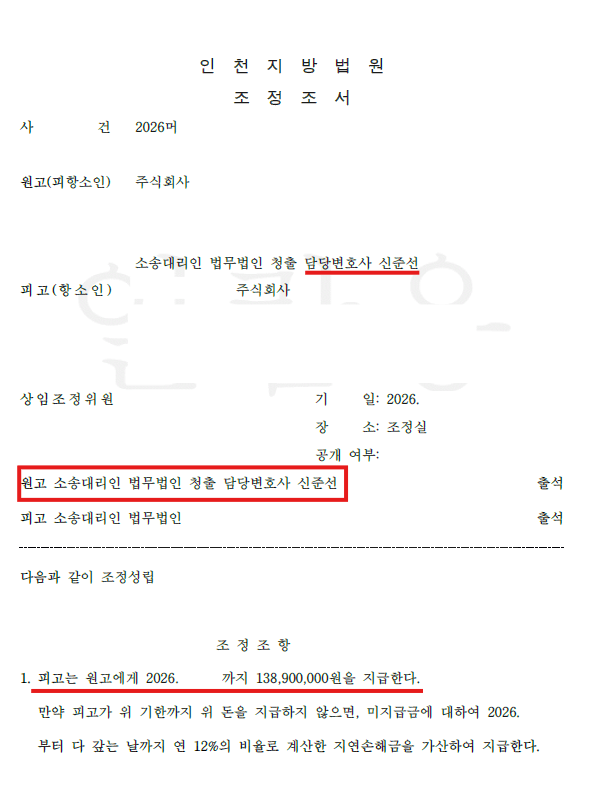
Law firm Chungchul (attorney in charge: Shin Junsun), representing the plaintiff chemical supplier, obtained a first-instance default judgment merely by filing a complaint for damages in a matter where the defendant metal-coating manufacturer refused to receive and pay for special chemicals that it had orally ordered in the so-called 'order-base (made-to-order)' manner. Thereafter, even though the defendant in the appellate court fully disputed the merits, including the existence and scope of the orders, we reached a settlement for an amount exceeding 80% of the claim amount stated in the complaint. This was a case in which, with hardly any of the issues raised by the defendant on appeal reflected in the settlement, the plaintiff's claims were in substance almost entirely accepted, achieving in a short period a result close in effect to a confession of judgment.
2. Case Background
The plaintiff chemical supplier had for a long period supplied special paints and thinners produced only at its overseas headquarters to the defendant metal-coating manufacturer, the sole domestic customer for such products. These paints and thinners had the characteristics that: ① there was no alternative demand in Korea, ② they were produced only at overseas factories, so shipping took several months, and ③ they had an expiration date, making inventory management virtually impossible.
Due to these product characteristics, the plaintiff and defendant had formed a continuing transaction relationship under the so-called 'order-base' method, in which the defendant estimated its demand in advance and placed orders, and the plaintiff secured the goods from the overseas headquarters and then sequentially supplied the quantities requested by the defendant. Under this transaction structure, the defendant placed orders for a considerable quantity of chemicals on several occasions, and the plaintiff had taken delivery of all of them from the overseas headquarters and was storing them.
However, citing a change in its internal production plan, the defendant unilaterally refused to receive and settle payment for the remaining ordered goods after receiving only a very small portion of the ordered items, and as a result the chemicals became unusable after their expiration date. Accordingly, the plaintiff filed a lawsuit seeking damages for the defendant's breach of obligation.
3. Legal Issues (Chungchul's Main Grounds and Issues)
The main issues in this case were: ① in a repeated transaction structure based on oral and telephone communications without a written contract, how to prove the formation and scope of each order; ② whether the defendant's duty to receive and duty to pay were recognized for so-called 'order-base' goods produced pursuant to the defendant's orders; and ③ in a special product with an expiration date, whether the supplier-plaintiff bore a duty to mitigate damages and how the amount of damages should be calculated.
A. Preemptive Proof of Ongoing Transaction Relationship and Order-Base Acceptance Obligation
At the complaint-filing stage, Law Firm Chungchul systematically collected and organized long-term call records between the responsible personnel of the plaintiff and defendant, messages between working-level staff, and materials related to orders with the overseas headquarters. In particular, because most orders were made orally based on the ongoing transaction relationship between the parties, we reviewed a vast amount of recorded evidence and went through the process of effectively presenting evidence. We structurally and from multiple angles proved: ① the fact and quantity of each order, ② that the transaction in this case was an ongoing order-base relationship under which the defendant bore a duty to accept delivery, and ③ the product characteristics and market structure showing that the plaintiff could not dispose of the products otherwise.
In particular, we highlighted the fact that the defendant's person in charge had, in the ordinary course of dealings, expressly acknowledged the defendant's obligation to accept delivery for order-base orders and had made statements specifically confirming the fact and quantity of each order, thereby preemptively blocking the defendant's main rebuttal arguments that could be raised in litigation.
As a result, the first-instance court rendered a judgment fully granting the plaintiff's claim without a defense.
B. Response to the Defendant's Full-Fledged Challenge at the Appellate Stage and Early Settlement
The defendant, dissatisfied with the first-instance judgment, submitted new recorded evidence at the appellate stage and argued, among other things, that some of the orders did not exist, that the plaintiff had violated its duty to mitigate damages, and that damages should be calculated not as sales revenue but as the actual loss after deducting purchase cost, storage costs, and the like.
The appellate court then referred the case to settlement proceedings, and a settlement was reached under which the defendant would pay the plaintiff a lump sum exceeding 80% of the claimed amount.
4. Significance of the Case
This case has important significance in the following respects.
First, even though the defendant fully disputed the merits at the appellate stage, its arguments were hardly reflected in the settlement terms, and the plaintiff's claims were in substance almost entirely granted. This is a case showing that thorough preparation at the initial evidence-gathering and complaint-drafting stages can effectively determine the outcome of the entire case.
Second, even in a long-term transaction relationship repeated by oral and telephone communications without a written contract, the systematic collection and reconstruction of communication content and circumstantial evidence between the transacting parties made it possible to prove the formation of each order, quantities, and the legal nature of the transaction method (order-base), making this case significant as one that led to the resolution of a repeated-transaction B2B dispute without a contract.
Third, in an order-base transaction involving special products with an expiration date and no alternative domestic demand, this case is noteworthy as one that confirmed that the counterparty's unilateral refusal to accept delivery constitutes a breach of obligation toward the supplier and enforced liability for damages accordingly.
If you need strategic resolution of payment settlement or damages disputes arising from a transaction relationship that has repeated without a contract, especially in a complex B2B matter where the counterparty denies the fact of ordering, the quantities, or even the duty to accept delivery itself, Law Firm Chungchul will help you.


서울 강남구 테헤란로 403 리치타워 7층
Tel. 02-6959-9936
Fax. 02-6959-9967
cheongchul@cheongchul.com
개인정보처리방침
면책공고
© 2025. Cheongchul. All rights reserved