1. Introduction (Summary of Results)
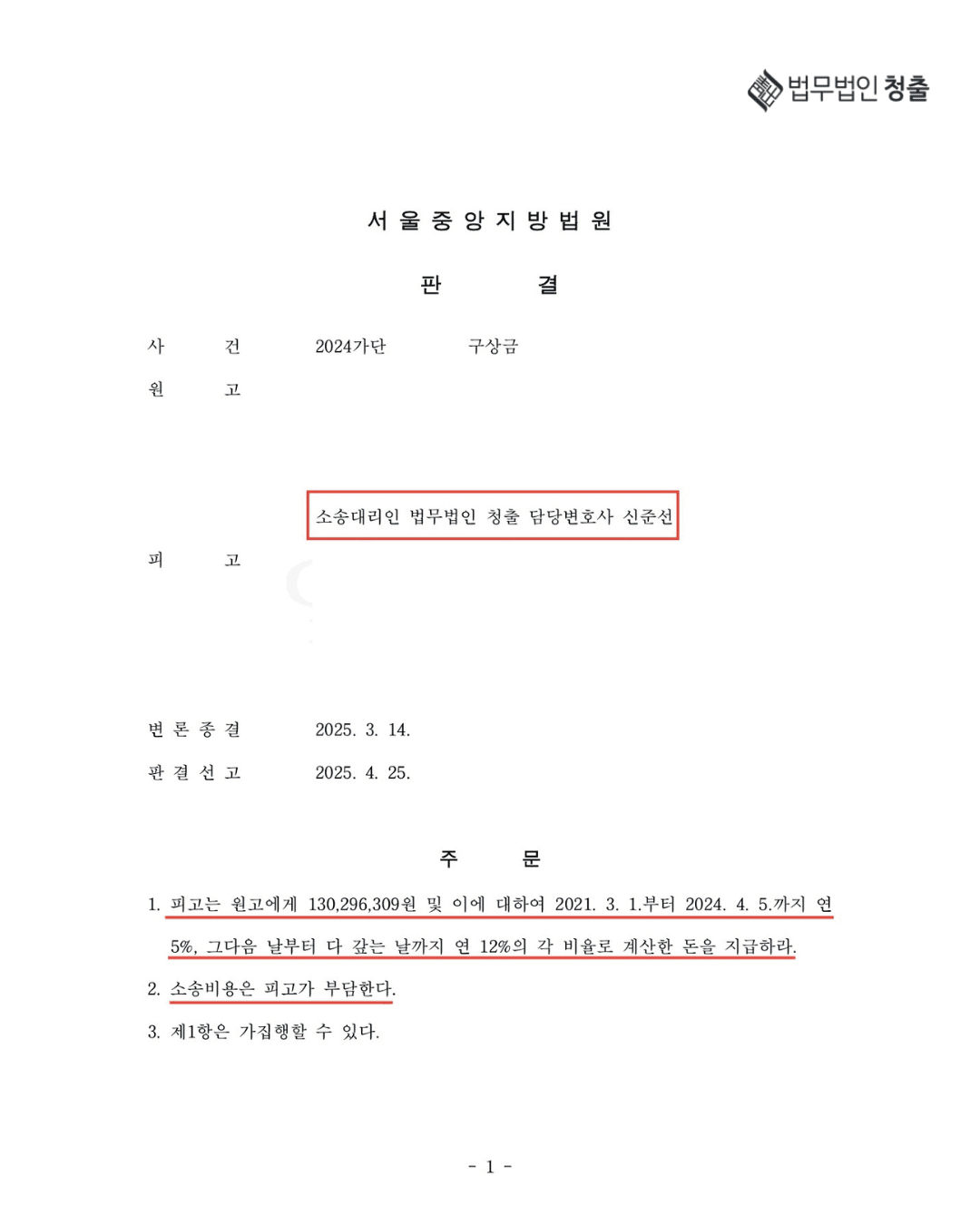
The law firm Cheongchul (Lead Attorney: Shin Jun-seon) successfully obtained a complete victory ruling that grants the full claim amount of over 160 million won, including 130 million won that the defendant construction company must bear and more than 30 million won in delayed damages, paid in advance by the plaintiff construction company to the bereaved family, related to an industrial accident that resulted in the deaths of four individuals at a highway maintenance site.
This case is a representative example of reconstructing an extremely complex compensation settlement structure involving multiple perpetrators, numerous victims, different payment timings, and various agreements into the most legally favorable approach for the client, leading to a complete victory.
2. Case Background
A serious accident occurred at a highway structure maintenance site, resulting in the deaths of four workers due to the collapse of the facility. The investigation revealed that the facility was constructed through a multi-step process involving the original contractor, subcontractor, re-subcontractor, and manufacturing company, and it was confirmed that the fastening part of the facility was not constructed according to the design in the final construction stage.
Immediately after the accident, the plaintiff construction company took full responsibility for the funeral of its employee who was the victim and negotiated with the bereaved family to pay a considerable amount in advance. In a separate insurance litigation that the plaintiff's insurance company conducted, the ratio of fault among the parties involved in this accident (the facility manufacturing subcontractor and re-subcontractor, etc.) was determined by the court, whereby the plaintiff was recognized to have only a minor fault ratio since they were not involved in the installation of the collapsed facility.
After the accident, the plaintiff and the defendants reached an agreement to make compensation and additional payment in advance to the victims and their families and later to settle the amounts based on the fault ratio. However, the defendants had not paid the full amounts they were required to bear, and the plaintiff sought recourse from the defendants for the part exceeding their fault ratio in the total expenditures.
3. Legal Issues (Key Grounds and Issues of Cheongchul)
① Recognition of Recourse Rights Based on Internal Burden Ratio of Joint Tortfeasors
The defendants claimed, "The amount spent by the plaintiff is the amount paid in agreement with each bereaved family individually, so there is nothing to recourse to each other," arguing that specific items such as funeral expenses and tuition were costs that the plaintiff had 'uniquely agreed to bear.'
Cheongchul rejected all claims of the defendants by combining the following two axes.
(1) Existence of Plaintiff's Recourse Rights Based on Internal Burden Ratio of Joint Tortfeasors
The court clarified that there exists an internal burden ratio (fault ratio) among joint tortfeasors, and if one party pays more than their share, then the excess portion can be recourse to the other party.
(2) Establishment and Application of Settlement Criteria Based on the Agreement Between Plaintiff and Defendants
The defendants unilaterally interpreted the wording of the agreement between the plaintiff, defendants, and the bereaved families in a way favorable to themselves, claiming that certain items (funeral expenses, payment of tuition fees for the victim's children, etc.) were not subject to joint settlement.
However, Cheongchul asserted that the plaintiff and defendants had agreed separately shortly after the accident that 'the amounts paid in advance would be settled later based on the fault ratio,' and that the wording in the agreement with the bereaved families did not affect the internal burden ratio between the plaintiff and the defendants, leading to a ruling from the court that the settlement amount paid by the plaintiff, along with the funeral expenses paid in advance, as well as tuition fees that were to be paid subsequently, are all included in the recourse (settlement) targets.
② Blocking the Internal Relationship of "Settlement Recommendation Ratio" Claimed by Defendants
The defendants argued based on the settlement recommendation decision for one of the victims' families, where the plaintiff and defendants had paid amounts based on the same ratio, asserting that the internal burden ratio among joint tortfeasors was also the same.
In response, Cheongchul argued that the internal burden ratio among the plaintiff and defendants had already been determined in a separate finalized judgment and that the separate settlement recommendation decision was made to expedite recovery for the victim, hence had no impact on internal recourse relations. The court accepted this argument, completely rejecting the defendants' claims related to the separate settlement recommendation decision.
This complete victory ruling by the court was confirmed after the opposing party waived their appeal following the judgment confirmation.
4. Significance (Implications of the Case) – A precedent that clarifies the complex industrial accident settlement structure (Internal Burden Ratio of Joint Tortfeasors) among multiple parties
This case serves as an example that completed a settlement structure centered on the internal burden ratio of joint tortfeasors, establishing a recourse (settlement) method based on fault ratios among multiple parties, thoroughly separating the internal relationships of separate agreements for some victims, and recognizing various forms of prepaid costs, including funeral expenses and tuition payments, as recourse targets through a clear interpretation of settlement documents. It strategically interpreted and organized a complex settlement structure regarding amounts paid to multiple victims in a way that favored the client, leading to a complete victory ruling by the court.
To achieve a complete victory in this case of recourse claims, the law firm Cheongchul meticulously gathered and organized the circumstances of the agreements among the parties and bereaved families and each cost expenditure, logically developed the relevant legal principles regarding damages and recourse, enabling the rapid and safe protection of the client's rights.
If you need strategic solutions for complex recourse claims or settlement debt-related disputes, the law firm Cheongchul is here to assist you.


서울 강남구 테헤란로 403 리치타워 7층
Tel. 02-6959-9936
Fax. 02-6959-9967
cheongchul@cheongchul.com
개인정보처리방침
면책공고
© 2025. Cheongchul. All rights reserved