

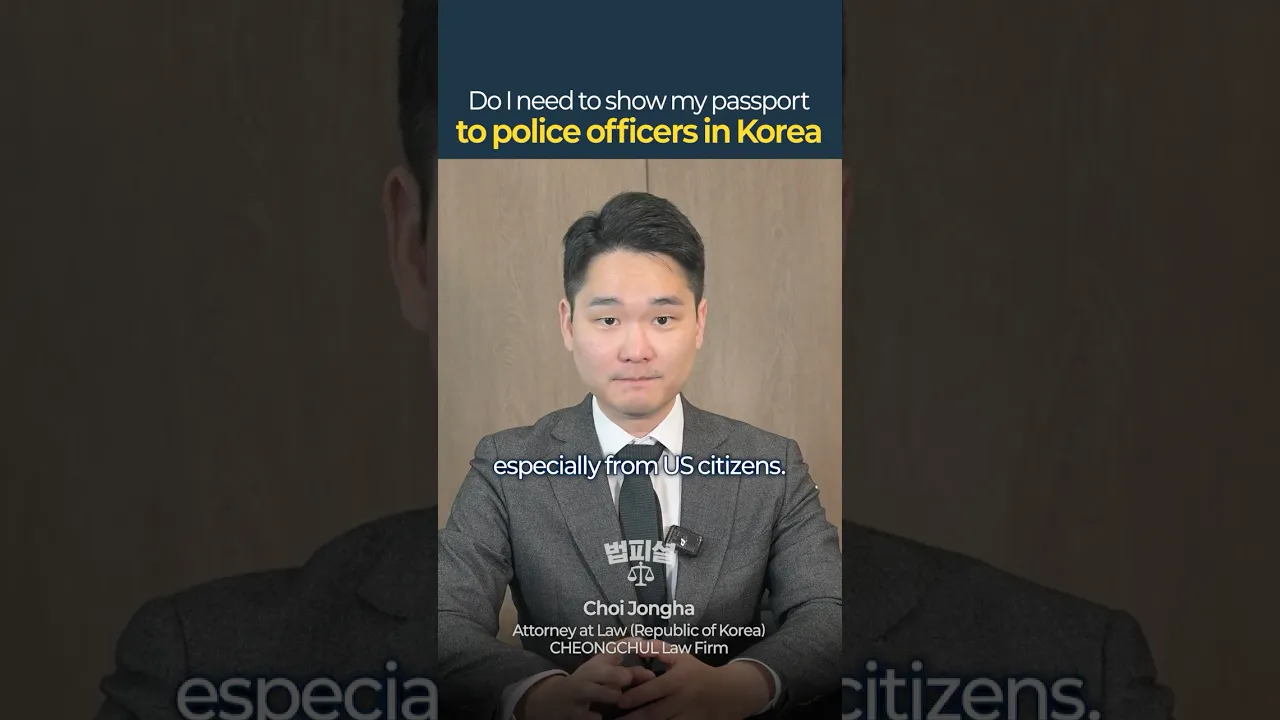
Many foreigners in Korea, especially those from countries with different legal standards, often wonder if they have the right to refuse a police officer's request to see their identification. However, under the Korean Immigration Act, foreigners have specific duties that differ from those of Korean citizens. In this post, Law Firm Cheongchul explains the legal obligations regarding passport carriage and the potential risks of non-compliance.
[Table of Contents]
The Duty to Carry a Passport: Is it Mandatory for Foreigners?
Police and Immigration Requests: Can You Legally Refuse?
Consequences of Non-Compliance: Fines and Future Residency Risks
Summary: How to Properly Respond to Identification Requests
1. The Duty to Carry a Passport: Is it Mandatory for Foreigners?
While citizens in many countries may have the right to refuse to show ID unless there is a reasonable cause to believe a crime was committed, the rules for foreigners in Korea are different. According to the Korean Immigration Act, every foreigner staying in South Korea has a legal duty to carry their passport or alien registration card at all times. This is a mandatory requirement under local immigration laws.
2. Police and Immigration Requests: Can You Legally Refuse?
In Korea, government officials, including uniformed police officers and immigration officers with proper identification, have the legal authority to request to see a foreigner's passport. Unlike the general principles that might apply to citizens, foreigners cannot simply refuse these requests based on a lack of "reasonable cause." If an officer asks for your ID, you are legally obligated to present it.
3. Consequences of Non-Compliance: Fines and Future Residency Risks
Violating the duty to carry or present a passport may seem like a minor issue, but it can lead to several complications:
Monetary Fines: Failure to comply can result in a fine of up to 1 million Korean Won (KRW).
Escalation of Tension: Refusing a lawful request often leads to unnecessary tension with law enforcement, which can escalate the situation.
Impact on Records: Such incidents can negatively affect your legal record in Korea, potentially causing issues if you plan to extend your stay, apply for a different visa, or revisit the country in the future.
4. Summary: How to Properly Respond to Identification Requests
To avoid legal trouble and ensure a smooth stay in Korea, follow these simple guidelines:
Always carry your original passport or your residence card (ARC).
If a uniformed police officer or an immigration official with a valid ID asks for your identification, be prepared to show it immediately.
Cooperating with lawful requests is the best way to protect your legal status and maintain a clean record.
Related work cases that are good to see together


서울 강남구 테헤란로 403 리치타워 7층
Tel. 02-6959-9936
Fax. 02-6959-9967
cheongchul@cheongchul.com
개인정보처리방침
면책공고
© 2025. Cheongchul. All rights reserved