

Hello, this is Cheongchul Law Firm.
If you have been taking care of your parents for a long time or have been devoted to their medical care, you may wonder, "Shouldn’t I inherit a little more for all my efforts?" In situations where it feels unfair to share equally with your siblings, how can this be resolved legally?
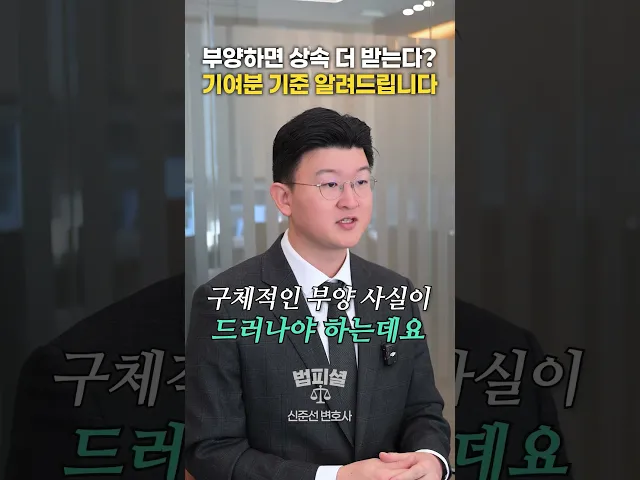
Today, through the videos on our YouTube channel [Legal Talk | Lawyer Cheongchul], we will clearly explain the essential requirements and proof methods for the 'Contribution System' which legally recognizes filial piety and devotion.
[Table of Contents]
What is the Contribution System? The relationship between supporting parents and inheritance
Criteria for 'Special Support': Simple cohabitation vs. special contribution
Requirements for Contribution Recognition: What needs to be prepared? (Proof materials)
Decision Process: Agreement and Family Court Judgment, and key strategies
1. What is the Contribution System? The relationship between support and inheritance
Many people think, "Since I supported my parents, I should naturally receive more," but to put it bluntly, that’s not necessarily the case.
However, our civil law has established the 'Contribution System' to promote substantial fairness among co-inheritors. The contribution refers to the system that grants additional inheritance assets in the distribution of the estate when there is a co-inheritor who has specially supported the decedent (the parents) or has contributed significantly to the maintenance or increase of the decedent's property.
In other words, if the contribution is recognized, it is possible to secure additional property beyond the statutory share.
2. Criteria for 'Special Support': Simple cohabitation is not enough.
The most important issue in a contribution lawsuit or consultation is the word 'specifically'. Merely supporting your parents as a child or spouse may fall under the ordinary obligation of support according to civil law.
Judgment criteria for 'Special Support' outlined by Cheongchul Law Firm:
Limits of simple cohabitation: Merely living with parents is not sufficient to be recognized for a contribution.
Level of support: It must exceed the ordinary level of support expected from a spouse or child.
Duration and method: The period of cohabitation must be long-term, and there must be concrete and devoted acts of support, especially such as caregiving.
3. Requirements for Contribution Recognition: Objective proof is key
So, what should you prepare to have your contributions recognized when you actually file for estate division? As emphasized in the video, objective evidence is essential over emotional appeals.
[Essential Checklist for Contribution Recognition]
Proving financial contributions: If you spent caregiving or living expenses from the parents' assets, it may be difficult to have your contributions recognized. You need to provide evidence of your out-of-pocket expenses for medical and living costs.
Specific proof materials: You must secure materials that can prove long-term cohabitation and caregiving, receipts of medical expenses and living costs you directly incurred, bank transfer statements, etc.
Comparative advantage: You must show a significant difference in contribution compared to other siblings (co-inheritors).
4. Decision Process: Not "I suffered" but "How much did I contribute?"
Contributions are not automatically recognized rights. In principle, they are decided through the agreement of all co-inheritors, but if an agreement cannot be reached, it will be determined through the family court's judgment (lawsuit).
In this process, the key to persuading the court is not emotional appeals like "I was very distressed emotionally and physically." The key to recognizing contributions lies in legally structuring and proving how specifically support was provided and what substantial contributions were made financially (cost burdens).
Inheritance disputes among family members involve not just legal conflicts, but also significant emotional strain. Especially contributions can vary greatly depending on the level of evidence, so it is important to gather objective evidence and develop a response strategy from the beginning with the help of professionals.
This post is intended to provide legal information, and legal judgments may vary depending on specific circumstances.
Related work cases that are good to see together


서울 강남구 테헤란로 403 리치타워 7층
Tel. 02-6959-9936
Fax. 02-6959-9967
cheongchul@cheongchul.com
개인정보처리방침
면책공고
© 2025. Cheongchul. All rights reserved