

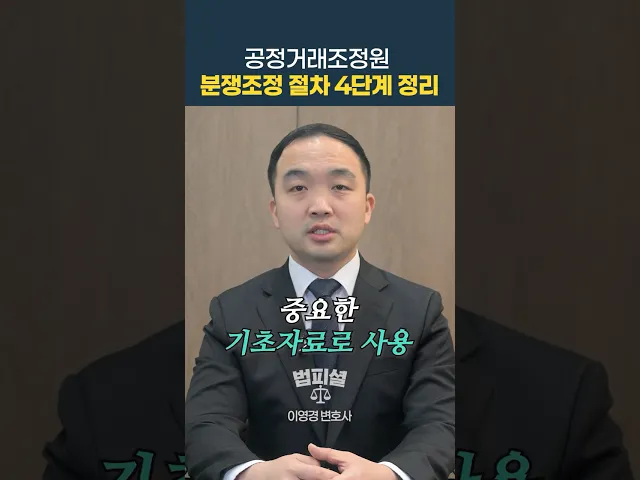
When disputes arise from unfair trade practices or violations of the subcontracting law with business partners, you can utilize the Fair Trade Mediation Committee's dispute mediation process as an alternative to litigation, which requires substantial costs and time. This article summarizes the four key procedures from the submission of the mediation application to the presentation of the mediation proposal, and explains the importance of writing the application and response forms and organizing the facts that must be attended to in practice.
Starting the Fair Trade Mediation Committee's Dispute Mediation Process: Submission of Mediation Application
Core of Exercising Right to Defense: Submission of the Respondent's Response and Counteraction
Substantive Proof Stage: Confirmation of Facts by the Investigator and Appearance of Parties
Conclusion of Dispute: Presentation of Mediation Proposal and Decision on Acceptance
Conclusion: The Importance of Strategic Initial Response in Fair Trade Disputes
1. Starting the Fair Trade Mediation Committee's Dispute Mediation Process: Submission of Mediation Application
The first action you can take regarding damage from unfair trade practices or violations of the subcontracting law occurring during business operations is to apply for dispute mediation with the Fair Trade Mediation Committee.
Key Point: The most important thing at the application stage is to clearly articulate the purpose of the application and the reasons legally.
Practical Caution: In practice, it is common for the application content to be inadequate, leading to delays in the process. It is essential to specify the concrete violations with the help of experts right from the first step, the application, for efficient process progress.
2. Core of Exercising Right to Defense: Submission of the Respondent's Response and Counteraction
Once the mediation application is received, the mediation committee notifies the other party (the respondent) of the relevant facts and demands the submission of the response within a specified period.
Importance: The submitted response becomes a vital foundational material for judging the case in the future.
Strategic Counteraction: It is the stage where you must logically counter the claimant's assertions and clarify your position based on objective evidence.
3. Substantive Proof Stage: Confirmation of Facts by the Investigator and Appearance of Parties
After the submission of the response, an investigator from the mediation committee will begin the specific confirmation of facts.
Procedure: The investigator may request additional materials from the parties or directly request their appearance.
On-Site Response: Typically, in practice, both parties will appear at least once to verbally explain their positions. At this time, how the facts are organized and communicated will determine the direction of the mediation.
4. Conclusion of Dispute: Presentation of Mediation Proposal and Decision on Acceptance
Finally, the mediation council comprehensively reviews the case and presents the final mediation proposal.
Ending the Procedure: If both parties accept the mediation proposal, the dispute is resolved immediately and has legal effect. Conversely, if either party does not accept, the mediation process is terminated.
Key Summary: The success or failure of the Fair Trade Mediation Committee's process ultimately depends on the three pillars of the application, response, and organization of facts.
Conclusion: The Importance of Strategic Initial Response in Fair Trade Disputes
Fair trade disputes involve numerous specialized legal issues such as the subcontracting law and fair trade law, unlike general civil lawsuits. Therefore, it is crucial to respond strategically from the initial stage through the review of legal experts for the protection of your rights.
The law firm Cheongchul analyzes fair trade cases directly with lawyers from prosecutorial offices and large law firms to provide optimal solutions. If you are experiencing difficulties during the Fair Trade Mediation Committee process or are concerned about damages caused by unfair trade, please feel free to contact the law firm Cheongchul.
Related work cases that are good to see together


서울 강남구 테헤란로 403 리치타워 7층
Tel. 02-6959-9936
Fax. 02-6959-9967
cheongchul@cheongchul.com
개인정보처리방침
면책공고
© 2025. Cheongchul. All rights reserved